
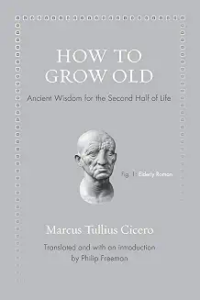
How to Grow Old: Ancient Wisdom for the Second Half of Life by Cicero 44 BCE
Marcus Tullius Cicero had been a leading participant in the Roman Republic before Julius Caesar crossed the Rubicon and created the Empire. Divorced, aging, and sidelined, Cicero repaired to his country estate in 45 BCE at the age of 62 and, instead of disappearing, wrote many of his most influential treatises on government, ethics, education, religion, friendship, moral duty, and aging.
This lovely volume featuring the Latin verso and its translation into English recto is one of a series of volumes published by the Princeton University Press providing ancient wisdom for today’s challenges. Cicero’s treatise on aging was dear to thinkers from Montaigne to John Adams and was important enough to Benjamin Franklin who published it in 1744, one of the first classics to be published in the new world.
Written in the form of a dialogue with two of his young friends,Philip Freedman’s introduction summarizes Cicero’s advice in 10 points: 1) A good old age begins in youth; 2) Old age can be a wonderful part of life; 3) There are proper seasons to life; 4) Older people have much to teach the young; 5) Old age need not deny us an active life, but we need to accept its limitations; 6) The mind is a muscle that must be exercised; 7) Old people must stand up for themselves; 8) Sex is highly overrated; 9) Cultivate your own garden; 10) Death is not to be feared.
Cicero’s own words are worth careful reading and consideration and this volume is easily read in one quiet sitting. Here’s an example of his wisdom: “Hours and days, months and years flow by, but the past returns no more and the future we cannot know. We should be content with whatever time we are given to live.” Sounds a lot like Montaigne, Chodron and Seneca. Cicero might even have been a Buddhist!
My Latin teacher for all four years at Oak Park-River Forest High School was Miss Violet Zielke, the archetypal spinster teacher. She would have been proud of my feeble attempts to read the Latin alongside the English. She instilled a love of language (albeit a dead one) , great writing (“All Gaul is divided into three parts!”, “I sing of arms and a man”, the former from Caesar’s Gallic Wars and the latter from Virgil’s Aeneid), and the study of wisdom from the past. Reading Cicero and Seneca brought back fond memories of her and her class. I recommend it.

