
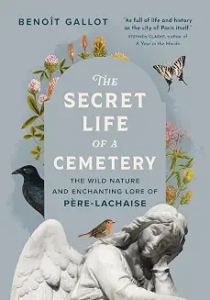
The Secret Life of a Cemetery: The Wild Nature and Enchanting Lore of Pere-Lachaise by Benoit Gallot 2025
Benoit Gallot is the curator of the Pere-Lachaise Cemetery in Paris, a position that caps a long career in funerary matters. Born on Halloween into a family of four generations of gravestone masons, he attended law school and entered an element of the family business when he became the general counsel for the Paris cemetery system before being appointed to his current role.
In this entertaining and informative book, he combines historical facts with anecdotes from his eight years at this famous cemetery, the resting place of Edith Piaf, Oscar Wilde, Jim Morrison, Honore Balzac, Frederic Chopin, Gertrude Stein and Alice B. Toklas as well as approximately 1.5 million others. Pere-Lachaise was created on the site of a former Jesuit monastery (Lachaise was a Jesuit priest and confessor to Louis XIV) by order of Napoleon in 1804 when the custom of burying people in Paris churchyards had led to disastrous collapses of buildings and walls. The cemetery was one of 20 cemeteries created in Paris by Napoleon. Situated in the far eastern section of Paris, it was relatively ignored until the remains of Moliere, LaFontaine, and Abelard and Heloise were moved there in 1817 at which point its popularity soared.
Today, the cemetery and its 96,000 graves are visited by thousands of tourists as well as those burying their loved ones or visiting their graves. Up to 50,000 visitors arrive on All Saints Day. Burial sites are available to all citizens of Paris on a first come first serve basis when a grave site opens up due to the expiration of a concession. The city of Paris owns the grounds but grants concessions which are sold to families for as little as 1000 Euros for a standard 10 year plot up to 50,000 Euros for a double plot in perpetuity. And yes, when your concession ends and you don’t renew it, you are exhumed and your bones placed in the ossuary to make room for the next sale. There are presently 640,000 concession agreements in the Paris cemeteries!
Pere-Lachaise, in additon to being the fourth most popular tourist attraction in Paris after the Eiffel Tower, the Arc de Triumphe, and the Louvre is also often visited by taphologists, those who study graves, headstones, and burial practices. It remains a working cemetery handling 23 hearses a day as well as 6000 cremations and more than 1000 burials each year.
In addition to this fascinating history, Gallot writes enthusiastically about the natural habitat the cemetery provides. More than 8000 trees adorn its 110 acres and foxes, cats, weasels, and numerous species of birds can be seen. This combination makes it a garden cemetery, and it became the model for similar facilities around the world. America’s first garden cemetery, Mount Auburn founded in 1831 is a short walk from our house in Cambridge, and I enjoy the beauty of its trees, shrubs, ponds, and wildlife during most weeks.
This is a terrific book about a fascinating place. I checked three books about Pere-Lachaise out of the library and chose this one. One of the rejects was more of a guide book and the third was entitled “Buried but not Quite Dead: Forgotten Writers of Pere Lachaise” by Anthony Daniels. Sounded fascinating but even I was unwilling to spend hours reading about writers who were probably deserving of being forgotten.
Interested in cemeteries, Paris, Napoleon, etc—read this delightful book.

