
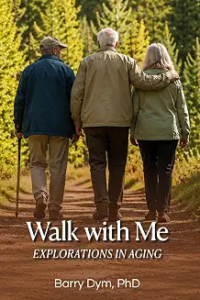
Walk With Me: Explorations in Aging by Barry Dym 2026
Before commenting on this insightful and engaging book, I must inform you that the author is a dear friend of more than 50 years, someone with whom I walk or drink coffee with on a regular basis, and with whom I’ve had many conversations about these topics.
That being said, I acknowledge the responsibilties of being an objective reviewer, so here are my reactions to “Walk with Me: Explorations in Aging”.
I love the title which is spot on. Rather than enfold himself in the legitimate role of an expert based on his experiences as a therapist, an advisor, a teacher, and a creator of organizations, Dym explores the realm of the aging, the elderly, the very old. In the best spirit of the French word from which ‘essay’ is translated as explore, to try out, to work out, Dym shares his own thoughts, ideas, and speculations about these topics often posing questions or alternative viewpoints.
He’s been working in this vineyard for more than 50 years beginning each day by writing in his journals, sitting in his comfortable beige chair. Ten years ago he expanded his writing from the daily journaling to include a blog,”Ruminations and Provocations” posting more than 1000 entries in the last decade. And finally, he organized some of those blog entries into this book with sections entitled: Aging, Retirement, Relationships, Reflections on Manhood, and Stories. Along the way, he has organized and led groups of aging people and couples.
Through it all, as he writes in the Introduction, his essays “try to describe old age as it actually is: how we anticipate and experience it in all its variety; the fears, the pains, the loneliness, and humiliations that are part of almost every day. But also the surprises, the pleasures, the dignity, and courage that we find in ourselves. And, perhaps most of all, the continual adjustments to change in our minds and bodies—and in the world around us. From where I sit, aging is best understood as an extended and continual journey of exploration, at times on familiar, friendly, or forbidding roadways. Come walk with me.”
The book differs from most of the others written on this topic by being more personal and less linear. Because these essays were written over 10 years, the book jumps back and forth in time. In one essay, Dym is 74 while in the next one he is 83, so the reader is constantly readjusting to different times, but the messages are consistent and coherent even if their chronology is not—aging is a time of continuous change and adaptation in which melancholy and enthusiasm, friendships and solitude, diminishment and creativity, and relationships with one’s spouse, children, and grandchildren play important roles.
Unlike some of the other books this month, Dym doesn’t bring a strong religious belief system to these thoughts though he is a semi-observant Jew and has worked deeply in meditation and Buddhist thought. He offers no solace in an afterlife or the nostrums of good eating, exercise, and doing crossword puzzles. Rather, he confronts the good and the bad of getting old directly and offers his own experience and insights for the reader.
As one would expect from this graduate of Harvard College and a Harvard PhD program, there are a slew of wonderful quotations from Emerson to Wallace Stevens, from Thoreau to Yeats, from Conrad to Drew Faust, and from two of my favorite writers, Penelope Lively and Donald Hall.
The book itself is rich in quotable moments, but this may be my favorite: “When I live my days fully, I don’t think very much about decline and death. I lose myself in the complexity and spaciousness of my life, which isn’t just a passage to death or to health. It is more like a field of flowers, streams, and rock formations, busy with people and ideas. Unlike a narrative or a pre-determined journey, the field is alive with possibilities. When I am present in those fields, my life takes on a timeless quality.”
Nice job, my friend.

