
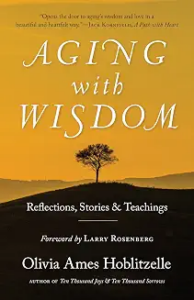
Aging with Wisdom: Reflections, Stories, and Teachings by Olivia Ames Hoblitzelle 2017
This book was recommended to me by a friend, a therapist who uses this book in teaching a course on aging for seniors. I ordinarily would have shunned it given its “self-help” format and its somewhat saccharine title, but once I began to read, I was hooked.
Hoblitzelle is a lifelong meditator, Buddhist, and teacher. Along with her husband, whose Alzheimer’s disease and progressive dementia and death play a large role in her approach, she has traveled widely in India. She also has a home in Vermont, which always makes me more interested.
The book is quite uneven with some wonderful sections and some that fell flat (e.g. the final section on Wayshowers), but I surprised myself in my eagerness to get back to the book in its early sections. There’s a lot of Buddhist wisdom that fits nicely with the Pema Chodron book, identifying the mysteries, wonders, and challenges of aging while providing suggestions for how to address them with equanimity, resilience, and courage.
Hoblitzelle frankly acknowledges the inevitable diminishment of aging but suggests that letting go of old patterns, taking a wider perspective, and cultivating an openness to the new and unknown will provide space for this new stage of life. She writes about the “ability to be with life in all its complexity, joys, and sorrows, with things as they are….” giving up craving for more and grasping at a life that has disappeared into the rear view mirror. She emphasizes the importance of self-love and self-acceptance, the being a friend to oneself, but not to be too self-preoccupied.
One quote sums up her philosophy for me: “The happiest people don’t necessarily have the best of everything, they just make the best of everything they have. Life isn’t about how to survive the storm, but how to dance in the rain.” A little to pat and cheesey? Perhaps, but it also rings true. Simplicity, patience, compassion—these are the nuggets of wisdom for aging.
This book will not be everyone’s cup of tea. There are parts that are way too sweet or religious, but overall, the message is a valuable one—if I’m lucky, I will continue to age, my physical and mental abilities will inevitably but hopefully gradually diminish.I can spend my time craving and grasping at what I am losing, or I can practice simplification, patience, and compassion as I enter this ‘uncharted territory’.
In her Conclusion, Hobitzelle lists the following as ‘important guidelines and seed thoughts for further reflection:
*Rejoicing in the blessings we still have. *Letting go of our struggle with life. *Acceptance of loss and change. *Seeing beauty in old age. *Cultivating lightness and humor. *Deepening awareness through meditation. *Opening to the unknown. *Making friends with death. *Cultivating the life of the spirit.”
It’s a pretty good summary of Montaigne, Chodron, Seneca, and back to where I started, Thomas Lynch! Worth reading.

