
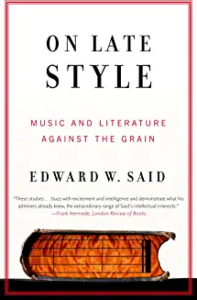
On Late Style: Music and Literature Against the Grain by Edward Said 2006
Said was one of our last public intellectuals, a professor at Columbia engaged in public debate about some of the most important issues of our time when he died at the age of 65 in 2003. This book was unfinished at the time, but his colleague Michael Wood completed and published the work based on Said’s early drafts supplemented by his lectures, essays, and commentaries.
Said characterized the life span of an individual as having three segments: origin, continuity, and the “last or late period of life, the decay of the body, the onset of ill health or other factors that even in a younger person bring on the possibility of an untimely end.” It is this final stage that Said focuses on, exploring how great artists acquire a ‘late style’ a new idiom in their work as they near the end of their lives .
Said, while acknowledging that some artists like Rembrandt, Matisse, Bach, and Wagner “crown a lifetime of aesthetic achievement with harmony and resolution”, focuses instead on those who “encounter intransigence, difficulty, and unresolved contradiction….It is this second type of lateness as a factor of style that I find deeply interesting… and explore the experience of late style that involves a nonharmonious, nonserene tension, and above all, a sort of deliberately unproductive productivenss going against the grain.”
This is a difficult read by any measure filled with long, complex, and erudite writing. Said formulates a theory of ‘lateness’, not necessarily the final works of authors and composers (as did Harold Bloom in his book of last poems, ‘Till I End my Song’) or about how they dealt with their imminent deaths (as did Katie Roiphe in ‘The Violet Hour”), but rather how their work was affected by aging, physical frailty, and ultimately, their approaching death. His scholarship is extensive and impressive. His insights are intriguing but his writing is incredibly dense, and I found it difficult to wade through. This is my shortcoming, not his, but passages such as the following, often left me a bit at sea: “Adorno exemplifies the European intellectual who refused to compromise with the culture industry as he saw it. His characteristic anti-identitarian notion is that of antinomian opposition, unresolved contradictions that he believed he existed to maintain, insist on, and gloss in a prose that—whether in German or in the various translations that have been made of it—remains permanently, fanatically difficult. As I also said, Adorno is lateness itself, hell-bent on remaining untimely and contrary in the Neitzschean sense.” And Said wrote that Adorno is ‘difficult’!
Through analysis and commentary on Adorno, Beethoven’s late string quartets and Missa Solemnis, Mozart’s Cosi Fan Tutte, Glenn Gould’s The Goldberg Variations, Lampedusa’s ‘The Leopard’, Thomas Mann’s novella and Britten’s opera ‘Death in Venice’, Jean Genet’s autobiography, and Cavafy’s poetry, Said advances his theory that ‘late’ works are a way of remembering time as the artist, unreconciled to infirmities of the present and unwilling to adopt the palliatives of the past, seeks out the future through a new process of self-making. The result is a new style, against the grain of the current culture, that sets the stage for the next period of progress, or in Gould’s case, a new interpretation of the past.
This was not an easy read and I’m sure that my understanding of Said’s thesis remains relatively shallow and superficial, but it was a fine introduction to a deep thinker with an awe-inspiring intellectual wing-span and who remains an important cultural influence in the 21st century. Said’s thesis also provides another analysis of how aging and imminent death can result in enhanced creativity and productivity.

