
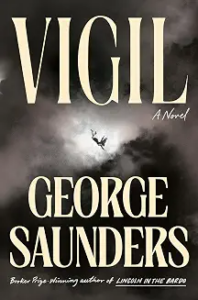
Vigil by George Saunders 2026
Saunders, who heads the creative writing program at Syracuse University, is a writer’s writer who remains largely unknown to the reading public despite his numerous awards which include the Booker Prize for his novel “Lincoln in the Bardo”, a MacArthur fellowship, and multiple National Magazine and O’Henry Awards for his short stories. I struggled with “Lincoln in the Bardo” abandoning it after 50 pages or so, but loved his two short story collections, “The Tenth of December” and “A Swim in a Pond in the Rain.”
In this slim novel, Saunders is both very funny and very serious. It’s the story of two main characters, Jill Blaine and K.J. Boone. The book opens with Blaine plummeting to earth outside the dying Boone’s mansion. She has been elevated (Never made clear, it appears that God or some heavenly committee determines who should be elevated and who should just drift around bardo for eons.)after dying in a car explosion meant to kill her cop husband shortly after they were married. She has comforted 343 dying individuals, helping them through the transition from life to the afterlife involving that bardo again. She has been sent to help Boone recant and atone for his life before he dies. Boone has lived a rags to riches story rising from a poor family in rural Wyoming to become the CEO of the most powerful oil company in the world, influencing political leaders and marshalling flawed science to refute the role of fossil fuels in climate change. Spurred by the repeated appearance of the dead Frenchman who invented the internal combustion engine, Blaine tries her best to get Boone to recant, apologize, and own the damage to the earth that he has done.
The dialogues are frequently very funny as are Saunders’ descriptions of the characters. At one point, two individuals stuck in the bardo appear, “a handsome black man and a rotund white woman who radiated a likable, perplexed kindness, as if, in life, her tendency to foul up the smallest thing had rendered her perpetually cheerful, placing her somehow permanently beyond humiliation.” But, amongst all the creativity in describing how the residents of the bardo keep appearing and disappearing as Blaine tries to get Boone to atone, there are some important themes that Saunders is serious about—climate change, greed and the wealth disparity, fake news and the disregard for science promulgated by the oil industry, sexism, and finally the biggie, free will.
Saunders wholeheartedly embraces the Robert Sapolsky doctrine of ‘determinism’. Here is Jill Blaine who had ‘merged’ her ethereal self with Bowman, the now 90ish year old man who had blown her up and gotten away with it. “He had left his mother’s womb with a particular predisposed mind and started living, and immediately that predisposed mind had run up against various events, and been altered in exactly the way such a mind, buffeted by those exact events, would be altered, and all the while, he Bowman, trapped inside Bowman, had believed he had been making choices, but what looked to him like choices had been so severely delimited in advance by the mind, body, and disposition thrust upon him that the whole game amounted to a sort of lavish jailing. His feelings (of rage, of shame, of being worthless, of needing to lash out pre-emptively at even the slightest threat) were all real and he must suffer them every day, and why? Because he had been born him. But he had not chosen to be born him. That just happened to him. And then life happened to that him, exerting upon it certain deleterious effects…At what precise moment could Paul Bowman have become other-than-Paul-Bowman?” This is Sapolsky in a single paragraph!
This commentary on free will and determinism from the musings of the chosen elevator, Jill Blaine, are typical of the brilliance of Saunders’ writing, whether about climate change or the deleterious effects of the wealth gap. I would urge you to read this book for its humor for sure, but also read it for the indictment of the oil industry and the pain and suffering coming our way from violent weather and drought. On the other hand, Dwight Garner reviewing the book in the New York Times wrote: “Saunders’s new novel, “Vigil,” is slim, about the size of Mitch Albom’s memoir “Tuesdays with Morrie” or Richard Bach’s novella “Jonathan Livingston Seagull.” It’s not as soft and shallow and saccharine and strenuously earnest as those books, but it’s not impossibly far off. It’s a hot-water bottle in print form. It’s going to be an enormous best seller for depressing reasons. So there you have it again, chocolate and vanilla. Your choice (unless, of course it’s already been pre-determined!).

