
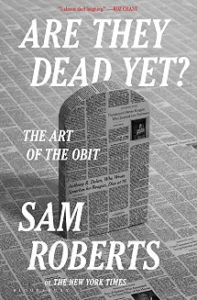
Are They Dead Yet: The Art of the Obit by Sam Roberts 2026
I saw this book in the window of the Harvard Book Store and couldn’t resist. Great title and perfect for a month of reading about death. It was a good decision.
Roberts is a real newspaper pro. He was a reporter and an editor at the New York Daily News before writing for the New York Times for 32 years. He spent the last 10 years as an obituarist (Yes, it’s in the Scrabble dictionary along with necrologist, but not obituarian.) writing an estimated 1600 obituaries that ran in the Times between 2014-2024 when he retired.
The book is chock full of funny stories, as Roberts lightens the load of daily dealing with deaths by sharing the humor, irony, silliness, and downright ridiculous behavior that often accompany the writing of these pieces. The most entertaining chapter in the book describes the process by which the obituarists review the day’s deaths, estimated to be around 150,000/day, to deterimine the few who warrant a NYT obit, how long it is, and whether it gains page 1 status. The standard obit runs 800-1200 words but some individuals scored far more words. It took the Times 13,870 words to write Pope John Paul II’s obit and Richard Nixon (13,155), Ronald Reagan (11,411) and George H.W. Bush (10,214) as well as Fidel Castro (8179), Ruth Bader Ginsburg (6827), Edward Kennedy (6119), Nelson Mandela (6508), and Frank Sinatra (5427) also racked up higher totals.
In addition to often writing an unexpectedly needed obit on ‘deadline’, Roberts also wrote many ‘advances’, i.e. obits written while notable people were still alive so the obituary was ready to go when the notable person unexpectedly died. The NYT keeps about 2000 of these at all times maintaining strict secrecy about who is in this distinguished company.
Two quotes illustrate the humor of this fine book. There is that first rule of obituary writing expounded by Stanley Walker of the New York Herald Tribune: “Make sure he’s dead.” and the lovely quip by the editor of another book about obituaries who wrote, “No matter how accomplished you were, if I’m reading your obit, I’m doing better than you are.” I laughed out loud quite often, always a sign of a good book.
On the other hand, Roberts also took his responsibility seriously. He wrote, “If death is final, if we retreat into the same unconscious state that we inhabited before we were born (there’s the Bede, Nabokov, and Chodron again!), we nonetheless leave behind a world different from the one we inherited. That difference may be sanctified, celebrated, or censored in an obituary; if someone decides we merit one. If not, the immediate impact of one’s presence, for better or worse, may pass by unsung. Writing obituaries has persuaded me that everybody has a story to tell; every life, no matter how seemingly mundane, can offer something to grasp onto. The obituarist’s job is to extract it, to transform those lessons into a narrative worthy of our readers and perhaps, in doing so, even to inspire them into doing something that might someday merit an obit, too. The people I write about in obituaries are never dead to me.”
Having read this book, I’ll now read obituaries with a more attentive mind and a more sympathetic viewpoint. Roberts has written a funny, thought-provoking, informative book.

