
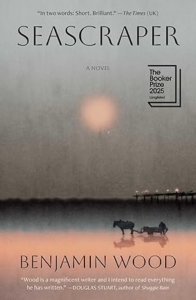
Seascraper by Benjamin Wood 2025
This book was longlisted for the Booker and was on a BBC list of the 25 best novels published in England in 2025, so when I returned from London, I obtained a copy from the CPL and read it. I was not disappointed.
In this, Wood’s fifth novel, we are deeply situated in Longferry, a run down village on the sea in northern England. Thomas Flett, a 20 year old living with his 36 year old mum, works as a seascraper, a shrimp fisherman who nets his catch by dragging nets across the bottom of the sea a couple of miles off shore when the tide is out. While others have moved to mechanized steam driven haulers, Tom continues to use the horse, wagon, and nets that his grandfather and great-grandfather used. His father had been a teacher at the school and impregnated his mother, 16 at the time, before being driven away and ultimately killed in France in WWII. Thomas barely ekes out a living with his non-stop dawn and dusk trips to the sea, soaking wet, smelly, and barely alive. His only love is his guitar and music, which he hides from his mum and is too shy to play in public.
When an American movie director appears in the Flett kitchen, Thomas sees a way out of this dismal day to day existence. Edgar Asherton proposes to use Longferry’s beach as the site of his upcoming movie and gives Tom’s mother a cheque for $100 to pay him to show him the sights. This does not end well for anyone, but I’ll stop here to avoid ruining the plot.
The story is a good one. The characters are alive and intersting. The theme of family is foremost in all the action. Tom’s relationship with his mum and his long dead father, the relationship between Edgar and his old mother—these are the strong currents running through the book. The sea-side village setting, however, is the real center of this fine novel. Wood writes about the sea and the shore and the young Tom trying to figure out life with great beauty and sensitivity. Here’s his take on Tom one evening: “He gets beneath the sheets and finds the comfy dip his weight has fashioned in the mattress. Sleep is coming—he can sense it, blurry in the outer limits of his mind like weather stirring up the dune grass far aways, and he surrenders to the feeling, but it doesn’t take him.” And here is Wood’s description of the beach: “The sharpness of the sale inside the nostrils, too. The festering scent of bladderwrack, which lies along the foreshore here like clumps of hair upon a barber’s floorboards. There’s a strange, spasmodic crunch each time the wheels pass over razor shells and gnarls of driftwood.”
The writing is beautiful, the family relatonships are heartbreaking, and the story is solid enough to provide a framework for both of them. This would be a good book to curl up with on a winter’s night on Cape Cod or Nantucket with the sound of the waves in the background and the salty air to inhale. A good single malt Scotch and a fire in the fireplace wouldn’t hurt either.

