
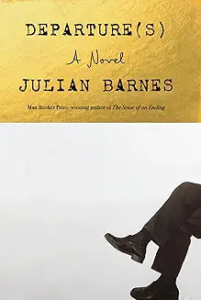
Departure(s): A Novel by Julian Barnes 2026
“Departure(s)” is Barnes’ 27th book. He is the recipient of the Man Booker Prize, the E.M. Forster Award, and the Somerset Maugham Award as well as honors from the French government. Along with MacEwan, Hutchins, and Amis, he’s widely regarded as one of England’s finest writers, the last members of that generation.
I included the phrase ‘a novel’ in the title of this review because this is clearly not your average work of fiction. In fact, I’m not sure it’s fiction at all despite Barnes’ specific label. The book is divided into five parts and most of them are narrated by the real Barnes while the remainder tell the story of Stephen and Jean. We meet them at four different stages of their lives, when they are students at Oxford and introduced by the narrator (?Barnes) but split up rather than marry, when they have lived apart for 40 years, when the narrator (? Barnes) helps them reunite and marry, and then after they divorce. Along the way, we are treated to Barnes’ observations about memory, death, writing fiction, and various authors including the Albanian Ismail Kadare who Barnes felt should have received the Nobel Prize. Melarme, Baudelaire, Rimbaud, Proust, Woolf, and Flaubert make cameos, but the real meat of the novel are Barnes’ aphorisms about memory and life/death.
Barnes goes on at some length about IAM, involuntary autobiographical memories citing the example of a man who could remember every pie he had ever eaten and then goes on to muse about the inaccuracy and distortions of most people’s memories. With regard to fiction, he writes that “fiction requires the slow omposting of life before it becomes useable material.” He goes on to write later in the book when musing about a story that may or may not have been true, “But then I have to give a place and time when an incident took place or the exchange would lack the modest depth of an anecdote. In my view, you can fudge the background if you respect the central, fundamental truth of the story,” He goes on to combine these thoughts about memory and writing with his own concerns about death, “You may have noted my habit of correcting mysef. When I was younger, I thought I knew what the world was like, what was true and hard, what malleable and soft. The need for self-correction comes with age, like the habit of repetition. It must have something to do with death and departure from this life.” And there it is on page 78! The departure from this life, the central concern of Barnes in this so-called novel. Yes, Stephen and Jean arrive and depart, but the main action is Barnes contemplating his own death, “We come from eternal nothingness and that is what we return to.” This is almost word for word how Nabokov in his memoir, “Speak, Memory” has characterized life and death, and very similar to Philip Glass’s take on it in his memoir as well.
Early in the book, Barnes indicates it will be his last one. Advancing age (like me, he’s recently turned 80), the diagnosis of a myeloproliferative disease which won’t kill him but also is not curable, and the ongoing loss of friends (Hutchins, Amis, and others) have shaken him but also ironically provided some equanimity regarding his upcoming erasure. He quotes Henry James among others regarding death and writes, “I don’t see many upsides to being dead”, but he thanks his readers for their ‘sturdy presence‘
The book ends with this wonderful passage: “I prefer an image of writer and reader on a cafe pavement in some unidentified town in an unidentified country. Warm weather and a cool drink in front of us. Side by side, we look out at the many and varied expression sof life that pass in front of us. We watch and muse…..Out of the corner of my eye, I see that you share my attendingness…Still I hope you’ve enjoyed our relationship over the years. I certainly have. Your presence has delighted me—indeed I would be nothing without you. So, I’ll just rest my hand briefly on your forearm–no don’t stop looking—and then slip away. No don’t stop looking.”
What a beautiful passage and how touching to see a writer fully exposed. Not sure why he needed Stephen, Jean, Mellarme, and the rest of the cast. The final page would have been enough for me.

