
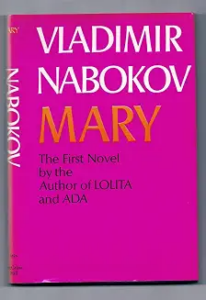
Mary by Vladimir Nabokov 1926
Nabokov is one of my literary heroes. All of his 20 novels and a number of biographies and critical studies about his work are on my bookshelf in Cambridge, and I often look upon them with pleasure and nostalgia. He was much honored in his lifetime with seven National Book Award nominations. His 1955 novel “Lolita” ranked fourth on the Modern Library’s list of the 100 best twentieth century novels in 1998 and is considered one of the greatest works of 20th-century literature. Nabokov’s “Pale Fire”, published in 1962, ranked 53rd on the same list. His memoir,”Speak Memory” published in 1951, is considered among the greatest nonfiction works of the 20th century, placing eighth on Random House’s ranking of 20th-century works. Despite all of this, he was never awarded the Nobel Prize, a terrible oversight!
“Mary” was his first novel. Written in Russian and published in 1926 it provides a fascinating comparison to his memoir, “Speak, Memory”. The themes of time, memory, dreams, and the sense of watching himself from outside, a shadow, a doppelganger characterize both books as does the theme of estrangement and exile.
We encounter six Russian emigres living in a dirty and run down pension in Berlin in 1923. The Russian Revolution which exiled the 19 year old Nabokov and his family to Berlin provides the backdrop to this story,and the six characters have varying attitudes towards their homeland.
The eponymous Mary, who never actually appears in the book, is the wife of Alfyrov, one of the residents of the pension, and is arriving in Berlin in seveal days after a four year separation from her husband. Mary also exists as the glorious memory of another resident of the pension, Ganin. Her imminent arrival stirs vivid memories for Ganin. He had been a 15 year old in the Russian countryside recovering from typhus when he met Mary, a beautiful and yielding young teen. Deeply in love, they parted when Ganin went to the front in WWI, and though connecting later in life, never again found love. As her arrival looms, Ganin’s memories of their early love are kindled, but he chooses to live with the memories and not the reality, departing Berlin as Mary is arriving.
This book has early evidence of Nabokov’s wordplay and humor as well as highlighting the themes that “Speak Memory” will develop further. It’ not a great book, but a fascinating look at this 20-something’s earliest work.
I found it interesting that Nabokov and Hemingway were both born in 1899 and both published their first novels in 1926. They remain among my favorites.

