
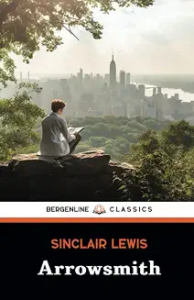
Arrowsmith by Sinclair Lewis 1925
We first meet Martin Arrowsmith as a young boy in Elk Falls, Winnemac (likely a conglomeration of Wisconsin, Michigan, and Minnesota) reading a medical textbook in the office of old Doc Vickerson. Fast forward to Martin in medical school at U of Winnemac, and off we go on this 540 page bildungsroman that sees Martin working as an intern at Zenith (? Ann Arbor) Hospital, a GP in Wheatsylvania, North Dakota the childhood home of his wife, Leora Tozer, a public health doctor and GP in Nautilus, Iowa, a pathologist at a classmate’s private surgical clinic in Chicago, a scientist at Professor Gottlieb’s lab at a private foundation in NYC, a scientist/doctor/public health official fighting the bubonic plague on the island of St. Hubert in the Caribbean where Leora dies, and finally a scientist working contentedly on science with his friend Terry in the backwoods of Vermont.
Exhausted yet? I certainly was as I struggled to keep up with this idealistic, naive, and prickly young man. The book packs more than one lifetime and way more than medicine between its covers, enough to earn Lewis the Pulitzer Prize in 1926 and the Nobel Prize in 1930.
If Hemingway championed the ability to tell a story in brief, direct, hard-hitting sentences eschewing adjectives and adverbs, all of those elements of writing evidently flocked to Lewis’s pen. The lists of adverbs, adjectives, nouns, etc. extend to the horizon as Lewis never fails to take the opportunity to describe in excruciating detail almost everything.
Nonetheless, it’s an engaging and well told tale of a young man’s search for meaning and purpose, and I liked it on this my second reading of it. Perhaps it’s because, like Arrowsmith, I wanted to be a doctor from an early age and often read medical books owned by my next door neighbor and pediatrician, Sam Bolonik. Also, Martin’s med school was almost certainly modeled on my alma mater, the University of Michigan. Finally, like Arrowsmith, I went through several medical careers searching for the right fit. And then, there’s Vermont!
There’s an additional backstory to this tale. While searching for a topic after his successful but rather pedestrian “Main Street” and “Babbitt”, Lewis was introduced to a young bacteriologist in Chicago, Paul de Kruif, (PhD bacteriology, U. of Michigan) who urged him to write about a doctor and promised to help him. Lewis was already drawn to write about medicine with an older brother, father, uncle, and grandfather all physicians, and de Kruif, who was teaching bacteriology at the U of Michigan Medical School was steeped in the science that Arrowsmith was to become involved with through Gottlieb, a pure scientist modeled on de Krief’s mentors. Lewis and de Krief signed an agreement to collaborate with the approval of Harcourt and set off on a long voyage to the Caribbean that ended in London where Lewis wrote the book.
When the book became a major success, Lewis reneged on the original agreement for 50/50 credit on authorship and 75/25 split of the royalties. He and de Kruif fought over these issues with Lewis ultimately publishing the book without acknowledging de Kruif’s contributions and de Kruif receiving some royalties. de Kruif did, however, learn how to write by working with Lewis, and he went on to write a series of successful science books for the general public including his best selling “Microbe Hunters”. I have several of his books in my library.
Bottom line is that this is a book that is steeped in its time but also confronts universal issues. It’s a classic by any measure, and though Lewis ended up with the accolades, de Kruif’s and my alma mater’s association with it lives on.

