
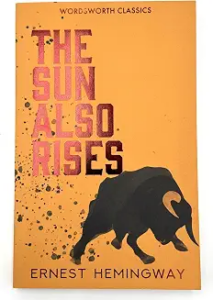
The Sun Also Rises by Ernest Hemingway 1926
Hemingway was born in 1899 and grew up in Oak Park, Illinois and from my high school. He has always been one of my heroes and favorite writers. His time in Paris in the 1920’s after driving an ambulance and being wounded in WWI memorialized in “A Moveable Feast” and the basis for his novels “For Whom the Bell Tolls” and “A Farewell to Arms” has served as the model for my ideal time and place to be alive.
I’ve read “The Sun also Rises” at least four times now, but found this reading to be quite different. It underlines the importance and impact of re-reading. As Herodotus said in reference to a river, you can never read the same book in the same way twice. The words remain the same, but you and the world have changed.
What I have always thought of as a tale of a romantic, exciting, joyful, and youthful trip to Spain with close friends and lovers to watch the running of the bulls and the bullfights in Pamplona turns out to be a depressing story about lost souls (ala Gertrude Stein’s quote about the ‘lost generation’) drinking, fighting, and damaging each other as they search for meaning and purpose. It also is distressingly anti-semitic. The book begins with a negative description of Robert Cohen, a Princeton graduate and a boxing champion, who is consistently insulted and beaten on by the other characters, none of whom are very happy. At one point he is referred to as a’kike’.
The other characters are not a happy group either. Jake Barnes has been wounded in the War and is impotent though deeply in love with Lady Ashley, Brett. Brett in her turn is on the rebound from two failed marriages and while engaged to the Scot Michael Campbell, sleeps with Cohen and then the 19 year old matador Pedro Romano. Along the way we meet other assorted men and women in their 20’s, wandering drunkenly through Europe and seeking some meaning.
“The Sun Also Rises” has been called Hemingway’s “greatest work” by Jeffrey Myers, Hemingway’s biographer, and the Hemingway scholar Linda Wagner-Martin has called it his most important work, but I may have to reassess my opinion of Hemingway especially given the casual anti-semitism shared by all of his characters. I’ve read and relished all of his books, especially loving his short stories about fishing in Michigan. I may also have to reassess my wish to have lived in Paris in the 1920’s given how grim and damaged its denizens appear to have been.
Glad to have re-read this classic and to have reassessed my youthful opinion of it and its author.

