
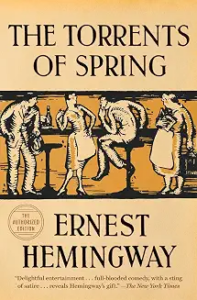
The Torrents of Spring by Ernest Hemingway 1926
Hemingway burst on the scene in 1926 with what many consider his finest novel, “The Sun Also Rises” as well as “The Torrents of Spring”, a slim novella which he apparently wrote as a reaction to Sherwood Anderson’s “Dark Laughter”.
Born in 1899 in Oak Park, Illinois, Hemingway worked as a newpaper reporter in Kansas City, was wounded while driving an ambulance in Italy in WWI, worked as a reporter for the Toronto Star in Paris, married Hadley Richardson, had a son, and became a member of the Parisian literary scene befriended by Gertrude Stein, Ezra Pound, Ford Maddox Ford, and others.
While “The Sun Also Rises” is the classic example of Hemingway’s style–concise, direct, bare-boned, eschewing adjectives and adverbs—“The Torrents of Spring” is quite the opposite. Its melodramatic and hyperactive style is evident in the first paragraph which begins with a Heminwayesque sentence and then goes off into the Andersonesque style. “Yogi Johnson stood looking out of the window of a big pump-factory in Michigan. Spring would soon be here. Could it be that what this writing fellow Hutchinson had said “If winter comes can spring be far behind” would be true again this year?
The book was rather painful to read as Hemingway wrote ironic purple prose with the same relish that he wrote his own style. Stein, Dos Passos, Fitzgerald, and others enter the story, but the parody would have been better as a short story, even shorter than the novella. Generally ignored in favor of his later work, the book is important because it was the first Hemingway book accepted for publication by Max Perkins at Scribner and Sons beginning a life long relationship between this great pair, the leading editor and publisher and the leading novelist of the mid-20th C.
If you’re looking to read an early Hemingway, and I hope you are, read “The Sun Also Rises” or even better, read his last novel, “The Old Man and the Sea” which led to his Nobel Prize in 1954.

