
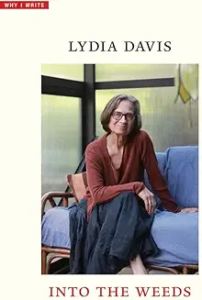
Into the Weeds by Lydia Davis 2025
Davis, one of our most eclectic, versatile, and weird authors, has written a wonderful and strange book. Based on her 2024 keynote address at the ceremony for the Windham-Campbell literary prizes awarded each year by Yale, the book ostensibly began Davis pondering how to answer the Prize Committee’s request that she address the question of why she writes. Her exploration of that brief, relatively straightforward interrogative has resulted in this delicious stew of a book.
The author of six collections of fiction, two volumes of essays, and numerous translations from the French including Flaubert’s “Madame Bovary” and Proust’s “Swann’s End”, Davis was a 2003 MacArthur Award recipient and won the Man-Booker Prize International Prize in 2013. Her “Collected Short Stories” includes some that are only one or two sentences long and are referred to as ‘flash fiction’. That book was listed as one of the 21st Century’s 100 best books by the New York Times.
In this delightful romp through the existential question of ‘why do I write’ Davis largely avoids answering the question by exploring why other writers write. She uses as her model for this approach John Ashberry’s Norton Lectures at Harvard in 1989-1990 entitled “Other Traditions” in which Ashberry (described by Davis as ‘my highest and most useful example for things‘) rather than talking about his own poetry or that of major poets, delved into the work of six rather lesser known poets including John Clare, Thomas Lovell Beddoes, Raymond Roussel, John Wheelwright, Laura Riding, and David Schubert.
With Ashberry as her example, Davis pretty much ignores the question posed to her and asks it of a long list of writers, from Gertrude Stein to Herman Melville, from Nabokov to Annie Dillard and Robert Finch, including a number of obscure authors and their even more obscure books. One such figure is George Sturt whose 1923 book, “The Wheelwright’s Shop” is a major focus for Davis. She admires the precision of his observations, the passion for his craft, and the detail about this art of wheel making and blacksmithing even as Sturt is unconcerned that there may be few if any readers who care about this topic.
In what might be the best summary of her attitude, here’s Davis summarizing her response to the original question. “When asked to write about why I wrote, I thought I might write only about how other writers write, I thought not only about writers who were willing to risk being tedious but also about writers who were in other ways difficult for some readers but similarly willing to be strange, to write about a certain subject, and in a certain way, no matter what—which to me is a sign of an essential dedication.” She goes on to cite Gertrude Stein, the obscure poet Laura Riding, Robert Musil, my all time favorite, Walter Benjamin, Ali Smith, Emily Dickinson and a Catalan writer, Josph Pla who spent 50 years annotating and elaborating a slim record covering 20 months of his life that he initially wrote at 21.
At the end of the day, Davis appears to conclude that ideas for her stories and poems come from ‘outside’ and if they arouse a keen interest or passion in her, she then devotes the time and effort to fashion fine sentences with balance, rhythm, and sound that convey to the reader the value she places on the idea.
I must admit that I didn’t come away from this lovely little volume with a clear idea of why Davis writes. But I loved reading the book with its multitude of worm holes, its plethora of trivial facts and names and titles, and its fundamental love of reading, writing, language, and observing. She is definitely a bit off of center, but I love her for it and will eagerly re-read this book for further suggestions for my To Be Read notebook. She also meets my primary criteria for an essay writer—I’d love to share a meal or a glass of wine with this fascinating woman, who at 78 would be an appropriate companion for this reader.

