
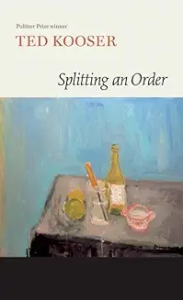
Splitting an Order by Ted Kooser 2017
Ted Kooser is one of my favorite poets—plain spoken, deeply sensitive, loving his Nebraska home, and totally tuned in to the meaning of reaching his 75th birthday the year he published this book, his 22nd volume of poems. The U.S. Poet Laureate in 2004-2005 and the winner of the Pulitzer Prize for Poetry in 2005, Kooser is far less known than he deserves.
I read this book 11 years ago and wrote the following: “Kooser published these poems on the occasion of his 75th birthday when time, aging, death, and the company of others were at the front of his mind. These are plain poems, without rhyme or much in the way of fancy enjambment, but they are full of metaphors which gently guide your mind into the world that Kooser grew up with, lived, and is now moving towards the end of. Nature figures prominently—trees, weather (especially rain, thunder, and lightning), leaves, ponds, tree frogs, an opossum in the barn, a dead mouse in the trap, a dead bat in the day bed. His people are frequently in pairs (hence the title) whether they be male friends, female friends, father and son, husband and wife, each helping the other through the ‘narrows and into the generations.’ Continuity of family is prominent. I loved his observations about letters and how the ‘r’s at the end of ‘father’ and ‘forever’ point to the future. These are poems to be re-read and treasured quietly all in one sitting.”
I liked this book even more this time around. In “Closing the Windows” he write about his father who closed the windows as a thunderstorm neared. Kooser wrote “It was all so ordinary then/to see him at the foot of the bed,/closing a squeaky window,/but more than sixty years have passed/and now I understand that it was/not so ordinary after all.” Here’s his title poem which is quite beautiful:
Splitting an Order
I like to watch an old man cutting a sandwich in half,
maybe an ordinary cold roast beef on whole wheat bread,
no pickles or onion, keeping his shaky hands steady
by placing his forearms firm on the edge of the table
and using both hands, the left to hold the sandwich in place,
and the right to cut it surely, corner to corner,
observing his progress through glasses that moments before
he wiped with his napkin, and then to see him lift half
onto the extra plate that he asked the server to bring,
and then to wait, offering the plate to his wife
while she slowly unrolls her napkin and places her spoon,
her knife, and her fork in their proper places,
then smooths the starched white napkin over her knees
and meets his eyes and holds out both old hands to him.
And here’s the first poem from this book. After reading it, I knew I was in the hands of a master craftsman:
Two Men on an Errand
The younger, a balloon of a man
in his sixties with some of the life
let out of him, sags on the cheap couch
in the car repair shop’s waiting room.
Scuffed shoes, white socks, blue trousers,
a nondescript gray winter jacket.
His face is pale, and his balding head
nods with some kind of palsy. His fists
stand like stones on the tops of his thighs —
white boulders, alabaster — and the flesh
sinks under the weight of everything
he’s squeezed within them. The other man
is maybe eighty-five, thin and bent
over his center. One foot swollen
into a foam rubber sandal, the other
tight in a hard black shoe. Blue jeans,
black jacket with a semi tractor
appliqued on the back, white hair
fine as a cirrus cloud. He leans
forward onto a cane, with both hands
at rest on its handle as if it were
a steering wheel. The two sit hip to hip,
a bony hip against a fleshy one,
talking of car repairs, about the engine
not hitting on all the cylinders.
It seems the big man drove them here,
bringing the old man’s car, and now
they are waiting, now they have to wait
or want to wait until the next thing
happens, and they can go at it
together, the younger man nodding,
the older steering with his cane.

