
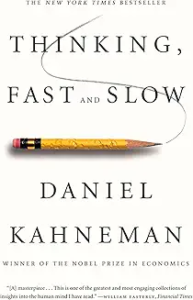
Thinking Fast and Slow by Daniel Kahneman 2011
Daniel Kahneman died on March 27, 2024 which should have disqualified him for inclusion in this In Memoriam issue of BookMarks, but his death was not revealed until March of this year. When the news broke, his mode of dying was so distinctive and startling that I misremembered it as occuring much more recently—a perfect introduction into the topic of his book which is how humans make poor decisions.
Kahneman, an Israeli-American psychologist won the Nobel Prize in Economics in 2002 for his work with Amos Tversky on behavioral economics. This book is his attempt to translate complex psychological concepts into lay language and explain how we make decisions and behave in ways that are often misguided ending up with poor results.
And here I must confess that I did not read this entire book. It was my second attempt to read it, the first several years ago ended in early failure. This time, I managed to get 50% of the way through it and then read the Conclusion carefully, but still came away somewhat befuddled. Is it my age that now prevents me from grasping complex concepts? Is it the fact that I may be the only member of the Boomer Generation who didn’t take a single psychology course in college? Is it the basic difficulty of my System 1 mind that interferes with my putting this story together, or is it, as most likely, a combination of all of these.
With that in mind, here’s my simplified summary of Kahneman’s thesis. He hypothesizes two modes of thinking which he dubs System 1 and System 2. System 1 is intuitive, rapid, automatic, effortless, and largely beyond our awareness and control It forms a view of the world through association, memory, and learning and is quick to offer an opinion or make a decision. It is often unduly influenced by external factors and its need to provide a coherent narrative of the world. System 2 is effortful, orderly, focused, indolent, and lazy. It is the part of our brain that analyzes, weighs, and attends to detail preventing major errors and keeping us in our lane, but it is usually off-line and only moves into action when we are aware that System 1 is failing.
Because System 1 is our first response, humans are prone to an entire panoply of factors that lead to poor decision making—representativeness, priming, anchoring, WYSIATI (what you see is all there is), framing, and other elements that distract us from a correct assessment of probability. The need to provide a coherent narrative leads along with these factors to heuristic outcome biases which lead to overconfident decision which too often result in an extreme outcome. The bottom line for Kahneman is that humans are not inherently rational, i.e. we are not internally consistent in our beliefs. As a result he argues that we need to adopt a viewpoint of libertarian paternalism when it comes to economic behavior. In doing so, decisions are framed in a way that allows freedom of choice but ‘nudges’ us towards the better choices.
I am certain that I would have benefited from a complete, close reading of this remarkable book, but life is short and I am old. The big picture of a human dominated by a frail and often faulty frontal lobe whose major errors might be avoided by being aware of them will have to suffice. It is true that in the myriad of examples and fascinating tests that Kahneman cites, I did well on those that I remembered from my first foray into this book. My performance began to slip as the mathematics got more complex.
Returning to Kahneman’s death in 2024 rather than this year, he chose to end his life just three weeks after his 90th birthday. It appears that he was as healthy as one can be at that age and was still thinking, writing, and teaching with skill and honor. Yet, he chose to fly to Switzerland and drink the medicine that would end his life. Kahneman had described himself as a very hard worker, “a worrier” and “not a jolly person”, and said that he was “quite capable of great enjoyment, and I’ve had a great life”. Richard Thaler called his close friend an “avid pessimist” who claimed that worrying was rational, “because he would not be disappointed as much with the outcomes of life.”
I’m sure that there is a profound message in this brilliant individual expressing his autonomy in a decision that by any measure must be judged to have been rational. What more powerful example of a System 2 response to this world can there be!

