
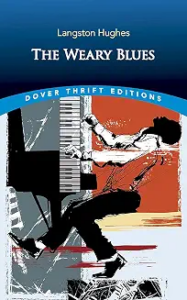
The Weary Blues by Langston Hughes 1926
Langston Huges (1901-1967) was a poet, playwright, novelist, essayist and social activist who is considered to be one of the leaders of the Harlem Renaissance, a period of flourishing of Black culture in the 1920’s and 1930’s. Graduating from Lincoln University in Pennsyvania, and Columbia in NYC, Hughes was a friend of Zora Heale Hurston and later Alice Walker. He wrote for the NAACP newspaper, a Chicago Black newspaper and is perhaps best known today for his poetry, including the final poem in this book, “Epilogue” now known by its first line, “I, too, sing America”, echoing Whitman’s poem of 50 years earlier.
I, too, sing America.
I am the darker brother.
They send me to eat in the kitchen
When company comes,
But I laugh,
And eat well,
And grow strong.
They send me to eat in the kitchen
When company comes,
But I laugh,
And eat well,
And grow strong.
Tomorrow,
I’ll sit at the table
When company comes.
Nobody’ll dare
Say to me,
‘Eat in the kitchen,’ then.
I’ll sit at the table
When company comes.
Nobody’ll dare
Say to me,
‘Eat in the kitchen,’ then.
Besides,
They’ll see how beautiful I am
And be ashamed,–
They’ll see how beautiful I am
And be ashamed,–
I, too, am America.
This, his first volume of poetry, contains some of his most famous work including “The Negro Speaks of Rivers.” The poems reflect his unwillingness to follow the middle class Blacks’ efforts to assimilate at the time but rather to revel in race consciousness and the ‘low life’ arts that Black writers, musicians, and painters were bringing to America—jazz. dance, song. Hughes is today, 50 years after his death considered to be one of America’s great poets as reflected in the Library of America’s volume of his work.
Interestingly, this Dover Thrift edition of “The Weary Blues” contains an introduction by Carl von Vechten a cultural critic who was one of Hughes’ major supporters and promoters. von Vechten, a white, gay man was controversial in his support for the Harlem Renaissance, especially after publication of his book “Nigger Heaven” also in 1926. As the executor of Gertrude Stein’s literary estate, von Vechten retains importance in the events of that time, but I’m guessing that Hughes would rather have had Ralph Elliison writer the intro to his book.
Nonetheless, another fascinating first book in 1926.

