
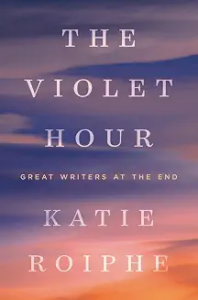
The Violet Hour: Great Writers at the End by Katie Roiphe 2016
This is a fascinating book, alternatingly brilliant and annoying, insightful and niggling, as Roiphe explores how five creative people faced their own deaths.
Motivated by her own experience with a life-threatening medical condition as a teenager and having watched her father die suddenly and unexpectedly, she sets out to address her own fears of dying by “writing about writers and artists who are especially sensitive or attuned to death, who have worked through the problem of death in their art, in their letters, in their love affairs, in their dreams. I’ve picked people who are madly articulate, who have abundant and extraordinary imaginations or intellectual fierceness, who can put the confrontation with mortality into words—and in one case images—in a way that most of us can’t or won’t.” As she writes in the Prologue: “I think if I can capture a death on the page, I’ll repair or heal something. I’ll feel better. It comes down to that.”
She goes on to write that “I don’t believe that you can learn how to die, or gain wisdom, or prepare, and the work I have done on this book has, if anything confirmed that suspicion, but I do think you can look at a death and be less afraid….There is something about the compression of the final moments, the way everything comes rushing in, the intensity that is beautiful, even though the death is not.”
Roiphe, a professor at NYU and the Director of the Cultural Reporting and Criticism Program, chose Susan Sontag, Sigmund Freud, John Updike, Dylan Thomas, and Maurice Sendak as her subjects with an epilogue reporting on her conversation with James Salter just weeks before he died. The chapters are uneven, and it felt like she never really figured out how to address this critical topic. In some cases, she ended up providing mini-biographies with less attention to the death itself, and in some cases, it felt like she was ‘cutting and pasting’ conversations with friends and family in an intrusive and often unimportant way.
There was, however, some real value amidst all of this mess. We learn that Sontag was fiercely committed to living as long as possible, traveling to Seattle for a third bone marrow transplant in the face of almost certain futility. For her, the suffering and pain were the costs associated with living and experiencing more. The negative impacts on her family and friends who were forced to pretend she wasn’t dying were substantial.
Contrast that with Freud, who refused painkillers because he wanted to experience and view dying with as clear a mind as possible. Updike, when faced with a diagnosis of metastatic lung cancer, refused a second round of chemo, withdrew to his study and finished his book of poems before quietly dying in the presence of his wife. Dylan Thomas, he of ‘raging against the night’ apparently drunk himself to death at age 39, dying in a coma at a NYC hospital surrounded by friends, wives ,mistresses, and camp followers. Sendak, in contast, lived to 83 and while never acknowledging that he was dying, planned his exit while ruing that he could no longer do his work.
What is clear is that each of these creative people had spent a great deal of their lives contemplating death and how it fit into their writing or painting lives. None of them were surprised. Other than Sontag and perhaps Thomas who raged and fought, the others accepted their lot but wished to continue their work to the very end.
So did, Roiphe or this reader emerge from the writing and reading with new knowledge or insight about dying? Perhaps. I did learn that when you’ve seen one death, you’ve seen one death. Each of these artists brought the entirety of their lives and experiences to the final episode, as will I and each of you. Each person will have to face the “jubilant horrible truth” as Updike put it, experiencing “the adventure that we’re all going to have.” How we do it and under what circumstances remain unknown and are likely to do so, until near or at the very end. As George Bernard Shaw said, “Don’t try to live forever, you will fail.”
One thing we can do, however, is to try to figure out the emotional landscape that might be the setting for this final act. Roiphe was clearly and powerfully affected by her childhood illness as well as by the sudden and unexpected death of her father. I don’t believe that the title of this book was chosen from “The Wasteland” randomly. She writes that “To me, the phrase evokes the mood of the elusive period I am describing: melancholy, expectant, laden. It captures the beauty and intensity I was finding in these scenes, the rich excitement of dusk. It is a poem obsessed with the nearness of death in many registers, irreverent, manic, and elegiac.” I don’t think it’s a coincidence that Roiphe’s daughter’s name is Violet.
