
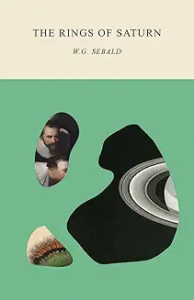
The Rings of Saturn by W.G. Sebald 1995
Sebald, along with Nabokov, Borges, and Roth, are on my short list of great writers who should have received the Nobel Prize in Literature but who were either overlooked during their lifetime or died before they could be so honored.
I’ve read all of Sebald’s novels and count them among the very best of books. I decided to re-read “The Rings of Saturn” which I first read in 2014 when we visited Margate this week. This seaside town in Kent is just south of where Sebald’s narrator completes his walk along the Suffolk coast. The tides moving in and out, the salt air, the endless wind, and the view of the North Sea enhanced this particularly fine literary experience.
Here’s my slightly edited review written 12 years ago which appears to have largely stood the test of time. “This is a spell-binding book in which Sebald, who died tragically at age 57 in 2001 in an auto accident, uses the same techniques he employed in “The Emigrants” to create a mysterious, modernist travelogue through space and time. Beginning with his description of a series of walks along the sea coast in Suffolk, from Lowestoft to Felixstowe, the narrator takes the reader on a fascinating series of unrelated tangents. The narration is taken up by characters as diverse as Thomas Browne (17th C physician and scientist, 1605-1682), Joseph Conrad (whose “Lord Jim” and “Heart of Darkness” clearly derived from his own nightmarish experience with the Congo and Belgian colonization), and Comte de Chateaubriand, and we learn about the North Sea herring industry, silkworm production in 19th C and Nazi Germany, the Chinese imperial succession during and after the Opium Wars, the poet Algernon Swinburne, the Irish Troubles, Napoleon and Waterloo, Edward Fitzgerald the English translator of the Rubaiyat of Omar Kayyham, and countless details of the less famous people, places, and stories that Sebald encounters on this journey.
The ‘connections’ this novel makes with my reading and my life have amazed me. First, another one of my favorite British writers, Jane Gardam in her Old Filth trilogy seems to draw upon Sebald since one her main characters, Terence Veneering’s hometown of Herringfleet makes an appearance as does Veneering’s place of death, Malta. One of Sebald’s characters visits Patmos’ ‘dark grotto’ which my daughter and I visited on our Yale trip years ago. The narrator stays at the Albion Hotel in Lowestoft, and some years ago, Susan and I stayed at the Albion Hotel in Miami Beach, and in perhaps the most interesting reference, in his tangent about Joseph Conrad, Sebald writes that Conrad’s family left Zhitomir in Ukraine to start his journey to Poland and eventually England. Zhitomir is also the town where my wife’s mother was born before her family fled the pogroms, ending up in Chicago where we met on a blind date 61 years ago!
Borges and his labyrinth, Kafka and Gregor Samsa’s dislocating metamorphosis, Descartes, Roger Casement (Irish patriot and English colonial critic), Rembrandt (and his painting of the Anatomy Lesson with meaning rather than accuracy), Buffon (and his calculation of pi=2L/xP), Gavrilo Princip (assassin of Archduke Ferdinand), Kurt Waldheim (in a swipe at the ability of modern Austria to forget its Nazi past) and Durer all make cameo appearances. Classical references abound including the very obscure: the two pilots whose deaths the gardener at Somerleyton recalls from WWII were from Versailles, KY and Athens, GA. The dislocation of emigration, the unreliability of memory, the sense of being lost in mazes and labyrinths, the connectedness and paradoxical randomness of all of life and living, anniversaries and dates of birth and death all contribute to Sebald’s dreamlike and mysterious aura. Sebald points out the ‘iniquity of oblivion” and ‘It takes just one awful second …and an entire epoch passes’ in reference to Somerlyton Hall and the formerly grand era of the late 19th All of life is transitory and we are all doomed to be forgotten. Other than that, it’s a cheery book. Sebald’s use of photographs is wonderful including one of him in front of a huge tree that the hurricane of 1987 took down. Everything passes…..
Since reading this book 12 years ago, I’ve become fascinated with another author who might be considered to be Sebald’s heir, Olivia Laing. She’s an English writer of novels and non-fiction, who like Sebald finds a loose thread and follows it into the past untangling its complex interactions as she goes. The randomness of events and their memory is a theme shared by both of these great writers, and in another one of those random (or perhaps not so random) events that Laing and Sebald both exalt, last week’s Times Literary Supplement featured a review of a new book about reading and books by Laing’s husband, Ian Patterson. This reinforces my opinion that there is some overall pattern to our lives which we are hopelessly unable to discern and that coincidences and random contacts provide small hints to that pattern.
Whatever your opinion of this, read Sebald, read Laing, and perhaps even read Patterson. I intend to.

