
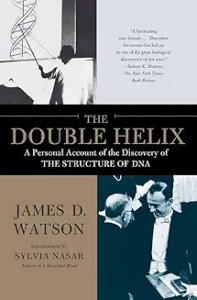
The Double Helix: A Personal Account of the Discovery of the Structure of DNA by James D. Watson 1968
James D. Watson died on November 6, 2025 at the estimable age of 97. He was only 23 when he and Francis Crick published a 900 word article in “Nature” in 1953 that revealed the double helix structure of DNA, the critical compound for transferring genetic information and for synthesizing proteins. Watson, Crick, and Maurice Wilkins received the Nobel Prize for this discovery in 1962.
This very early success in his scientific career resulted in a professorship at Harvard where he taught for 20 years before becoming the Director of the Cold Spring Harbor Laboratory and devoting his research to cancer. He led this effort until 2007 when he resigned after comments linking race and intelligence. His final years were marked by controversy and conflict about genetics, race, and gender. After his death, “The New York Times” called Watson one of the most important scientists of the 20th century while also acknowledging the controversy behind his racial views. The BBC noted that Watson’s work “opened the door” to help explain how DNA replicates and carries genetic information while also “setting the stage for rapid advances in molecular biology”.
I read this book ten years ago and found upon re-reading it, that my initial impressions still held. Here’s a portion of what I wrote in 2016: “In this slim volume, described by Modern Library as the seventh most important non-fiction book of the 20th C, Watson tells the story of the science and the personalities that resulted in this revolutionary discovery. Self-serving, self-absorbed, and self-promoting, Watson was a professor of biology at Harvard and a 41 year old celebrity when he wrote this book. White it is informative and fascinating, his treatment of Rosalind Franklin who would have received the Nobel Prize as well had she not died at the age of 37, was petty and unnecessarily nasty. His own ‘brilliance’ is highlighted ungraciously as well. Despite these flaws, the book tells a fascinating story of scientific progress, serendipity, and hard work that is typical of most major scientific breakthroughs—collaboration, building upon the prior work of others, the ‘aha’ moment, and dumb luck all played important roles. Worth reading for those who are interested in science and this pivotal moment in biology and medicine.”
On second reading, I am even more convinced that the book spent way too much time chit-chatting about teas, lunches, dinners, parties and other nonsense when it could have done a much better job of describing the science in an accessible way. The personalities of Linus Pauling, Sir Laurence Bragg, and various other colleagues and competitors were of interest, but again, way too detailed. Controversy surrounded the publication of the book. Watson’s book was originally to be published by the Harvard University Press, but Francis Crick and Maurice Wilkins, among others, objected. Watson’s home university dropped the project and the book was commercially published. In an interview with Anne Sayre for her book, Rosalind Franklin and DNA (published in 1975 and reissued in 2000), Francis Crick said that he regarded Watson’s book as a “contemptible pack of damned nonsense”. Don’t hold back, Francis!
Watson, had he not been a Nobel Laureate, probably would have been much more tightly edited and the resultant book much more enjoyable reading. Nonetheless, if one can plow through the minutia and silliness, it’s a fine portrait of how science often finds the right answer by wandering around in the dark with a candle.

