
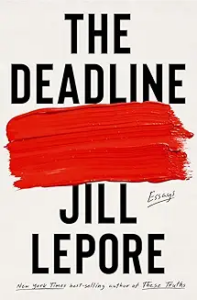
The Deadline: Essays by Jill Lepore 2023
Lepore, the David Woods Kemper ’41 Professor of History at Harvard University is one of the most prolific, insightful, and readable historians writing today. With works that span traditional historical investigation (e.g. “The Story of America: Essays on Origins”) to her timely essays in “The New Yorker” where she has been a staff writer for 21 years, she writes with humor, insight, and a fierce regard for the facts. As she has written ““History is the art of making an argument about the past by telling a story accountable to evidence.”, and her stories make for compelling, informative, and often very funny reading.
This volume, all 600 pages of it!, collects 41 essays published in “The New Yorker” between 2008 and 2022. She has grouped them under ten headings: Prodigal Daughter (biographical sketches of her family and early life); Misjudged (Mary Shelley’s “Frankenstein”, Melville’s “Moby Dick”, Eugene Debs, Rachel Carson, and Ruth Bader Ginsburg); Valley of the Dolls (perhaps my favorite section with essays about Ripley of Believe it or Not fame, Robert Ettinger who led the idiotic plan to freeze your body for later reanimation, the lawsuits around Barbie dolls, the BBC show “Dr. Who”, the dystopian novel, and the new VW Buzz); Just the Facts, Ma’am (novels vs. history, William Randolph Hearst and fake news, trump’s facts, the decline of local newspapers); Battleground America (gun ownership and the Second Amendment, Kent State, crisis in policing, the Kerner Report and other reports about racial strife); The Disruption Machine (the internet archive, HBS bullshit around disruption, robots, Facebook); The Rule of History (Magna Carta, constitutions, the Supreme Court, Guantanamo and torture, abortion and Alito); The Parent Trap (court rulings on education, contraception, sex panics, the Scopes trial); The Isolation Ward (plague, quarantine, loneliness), In Every Dark Hour (polls…..).
The defining characteristic of all of these essays is her conviction that facts derived from primary sources are the way that controversial topics clouded by conventional wisdom can be best sorted out, understood, and acted upon. Her take downs of ‘disruption’s father Clay Christenson of HBS, Facebook’s Mark Zuckerberg, and MAGA’s Trump are all brilliant and provide hope for the triumph of truth.
Two of the beautiful aspects of Lepore’s essays are their vivid images and very funny humor. In her essay about Robert C. W. Ettinger ‘who thinks death is for chumps’, she juxtaposes Merkle’s boner (Fred Merkle failed to touch second base costing the NY Giants the 1908 pennant), the Orpheus myth, and the 1964 movie Dr. Strangelove to point out the nonsense in the cryonics movement. Another fine example of her humor is her description of the new VW Buzz when she asks the reader to imagine, that a “Toyota Sienna got pregnant by a Tesla” and she manages to find the right imagery by writing that the VW Hanover, Germany factory is the size of 152 soccer fields. Along the way you also learn some fascinating trivia like the derivation of the London police force’s name, the Bobbies, from Robert Peel who as Home Secretary in 1829 persuaded Parliament to create the Metropolitan Police and the derivation of the term ‘lynching’ from the slaveholding judge whose name became a verb.
In summary, Lepore, while turning out Pulitzer Prize winning history books, writing long essays for The New Yorker several times a year, teaching undergraduate and graduate students at Harvard (I audited her brilliant class which served as the laboratory for her book “These Truths” several years ago), raising three children, and sustaining a long marriage, remains insightful, funny, quotable, and full speed ahead as she nears 60. This is a remarkable collection of essays worth reading from cover to cover or dipping into on a random basis.
One can only hope that Lepore stays busy and active for many years to come.

