
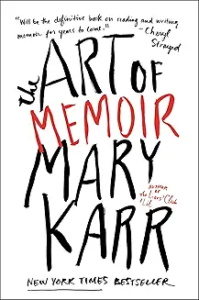
The Art of Memoir Writing by Mary Karr 2015
Karr is an award winning poet and essayist and a professor at Syracuse University where she has taught creative and memoir writing for more than 30 years. Given that one of her faculty colleagues is the incredible George Saunders, Syracuse must be among the best places to learn how to write.
This book reflects this experience of teaching as well as writing her own two best-selling memoirs, “The Liar’s Club” and “Lit” which describe her childhood with her alcoholic and abusive parents in East Texas and her divorce and escape from her own demons and alcohol when she converts to Catholicism.
This is an interesting book which is aimed at both the general literary reader as well as the memoir writer looking for help. The chapters are filled with literary allusions citing some of Karr’s role models for writing memoir—Maxine Hong Kingston’s “The Woman Warrior”, Michael Herr’s Vietnam War memoir, “Dispatches”, Robert Wright’s “Black Boy”, Maya Angelou’s “Why the Caged Bird Sings”, Orwell’s “Down and Out in Paris and London” and “Homage to Catalonia”, Elif Batuman’s “The Possessed: Adventures with Russian Literature”, Cheryl Strayed’s “Wild”, Tobias Wolff’s “This Boy’s Life” and his brother Geoffrey Wolff’s “Duke of Deception”, Frank Conroy’s “Stop-Time”, and her favorite, Vladimir Nabokov’s “Speak Memory” which is also mine.
Using these books as well as her own, Karr provides advice on the ‘art’ describing the four things you should have before embarking on writing a memoir: crisp memories (that carnal world in your head); stories and a passion to tell them; some introductory information or data to get across; the self-discipline to work in scary blankness for some period of time. Once you have those elements, proceed as follows: paint a physical reality that uses all the senses and exists in the time you’re writing about; tell a story that gives the reader some idea of your milieu; package information about your present self or back-story so it has emotional conflict or scene; set emotional stakes; think, figure, wonder, guess; change times back and forth; don’t exaggerate; revise, revise, revise and then rewrite.
Karr adds two elements to this book that I particularly appreciated. First, every chapter begins with a great epigraph, e.g. Blaise Pascal: “We know the truth not only by reason but also by heart”. Second, the book concludes with an appendix listing “Required Reading—Mostly Memoirs and Some Hybrids.” The alphabetical list of authors and their books goes on for six solid, tiny print pages beyond my patience to count, but incredibly comprehensive from Henry Adams to Kiren Zailckas.
This book is not for everyone, but if you like memoirs (like Dave Barry’s and Geoff Dyer’s in this month’s reading) then you’ll enjoy Karr’s breezy yet informative and deeply detailed book.

