
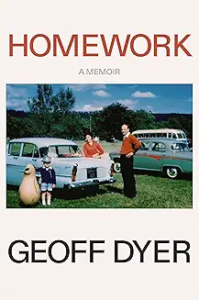
Homework: A Memoir by Geoff Dyer 2025
Dyer is among my very favorite authors. A Brit with a dry sense of humor, a seemingly infinite curiosity, and a compelling writing style, this is the eleventh book of his that I’ve read. The topics have varied from jazz to photography, from his experience living on a US aircraft carrier to a novel about Varanasi, India, and on and on. He’s brilliant, funny, insightful, and very readable, so when I saw this memoir of his in a bookstore, I grabbed it, one of the very few books I’ve actually bought in recent months as I’ve begun to downsize my libraries.
So imagine my disappointment when I found the book to be just so-so. As so many memoirs seem to do, it spent what felt like endless pages talking about details of his school days and chums, his miserly father and his passive, self-conscious mother, and the small town in England where he grew up. It wasn’t until the final two dozen pages when he wrote about his discovering books and his entry to Oxford that I felt he had hit his stride, and then the book was over when he was barely into his 20’s.
When I find myself disappointed in a book, especially one for which I had high hopes, I try to see if I’ve gone wrong by reading the blurbs and reviews. The ‘blurbists’ Billy Collins, Richard Ford, Jeffrey Eugenides, and Jonathan Lethem all heaped praise on the book, the first calling it a ‘masterpiece’ and the last saying it was ‘funny and beautiful’. Looking further, I discovered that another of my favorite British writers, the critic and Harvard Professor James Wood had reviewed the book in the New Yorker, and Wood’s brilliant review opened my eyes to what Dyer had actually been doing. Perhaps, as Wood writes, it is their common British Midlands middle class upbringing that gave Wood the insights and appreciation that I had lacked. Here’s the link to his review which I strongly recommend: https://www.newyorker.com/magazine/2025/07/21/homework-geoff-dyer-book-review.
At the end of the day, I think that my less than enthusiastic response to the book may have largely been due to the depressing, gray, and drab family life from which Dyer ultimately escaped. Adding another sad story to the day-to-day disasters that seem to endlessly roll out of trump’s D.C. was not what I had been hoping for. Nonetheless, one must count this book as yet another of Dyer’s triumphs even if it didn’t bring a smile to my lips.

