
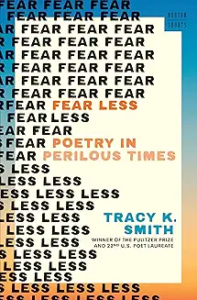
Fear Less: Poetry in Perilous Times by Tracy K. Smith 2025
Smith is a Professor of English and African American Studies at Harvard and the author of four books of poetry, one of which won the Pulitzer Prize. She served as the Poet Laureate of the U.S. from 2017-2018.
In this book, Smith becomes yet another poet who feels the need to defend and explain her craft. I’ve always been struck by the number of poets who have written books about their literary form, primarily to broaden the audience for poetry by demystifying its techniques, forms, and meanings. I can’t remember any books that do the same for novels, short stories, plays, or non-fiction. Yes, there’s a rich literature that explores how the novel works, but those books start with the assumption that the reader is already comfortable with that art form. Not so, the poets. Whether it’s Edward Hirsch’s “How to Read a Poem and Fall in Love with Poetry” or Terry Eagleton’s “How to Read a Poem” or many others, there seems to be a need to explain why poetry should be read and how to go about doing it.
Smith’s book, the latest contribution to this tradition, is a rich source of quotes about poetry and importantly, about why poets write as they do. One differentiating characteristic of poems appears to be the overwhelming need that the poet feels to get their reactions to the world and to their self down on paper, to articulate the often ineffable, to share those feelings with the reader and in doing so, to gain a better understanding of themselves and their place in the world.
Smith does this in four chapters about the unconscious, grief and accountability, strangers, and redemption before finishing with a chapter about “What Poems are and How They Do What They Do” (voice, title, images, form, closure). Throughout the book, she presents poems that illustrate her points, some by well known poets (Robert Hayden, Natasha Tretheway) but most by poets not known to me.
It’s not an easy book as Smith challenges the reader to be an active partner with the poet in bringing the words on the page to life, “poetry’s capacity to call to a reader’s empathy and curiosity.” Beyond this, she hopes for a greater role for poetry in re-establishing trust and the ability to talk and listen to those with different opinions during these divisive and difficult times.
Here’s her description of the ideal poetry reader: “readers willing to open their full feeling selves to being startled, challenged, and even possibly changed by the voice on the page.” And this is how she describes a poem: “A poem is a voice offering to build the world, by means of some crucial fragments, anew. A voice overcoming all manner of distance in order to soothe or astonish, entreat or rebuke. To ponder what has not yet been seen, what had eluded capture….Eventually a poem intercepts another consciousness by which it commences again to travel. This encounter occurs each time a poem is read, received, dwelled with, and carried off into the arc of another life. “
I think her writing about poetry as art is much more successful than her writing about it as a political or social force as in this view of poetry and politics: “…poetry is at heart a search and recovery mission which rejects the calculated deflections of power-based hierarchies in favor of an active and improvisatory empathy.”
The mixtue of literary criticism and politics whether about MAGA or race didn’t really work for me, but reading the book was a bracing experience as I continue to try to understand and enjoy this art form.

