
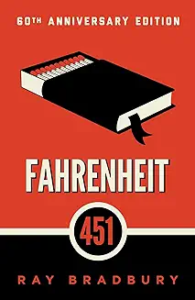
Fahrenheit 451 by Ray Bradbury 1953
Bradbury is a fascinating figure bridging the genres of science fiction and literature, books, movies, and television, and influencing contemporary writers from Stephen King to Neil Gaiman and creatives from Steven Spielberg to Margaret Atwood. ‘The New York Times’ described him as a writer “whose fanciful imagination, poetic prose, and mature understanding of human character have won him an international reputation” and “the writer most responsible for bringing modern science fiction into the literary mainstream.”
This book, his best known work, first appeared as a short piece in a science fiction magazine in 1950, and the full work was published in 1953. Drawing for its title from the ‘temperature at which book paper catches fire and burns’, Bradbury writes this dystopic novel only five years after the end of WWII, the end of the fascist regimes in Germany and Italy, the devastation in Hiroshima and Nagasaki after the first atomic bombs. and in the midst of the McCarthy Red Scare.
Guy Montag is a fireman, one of the men who respond to anonymous tips about people who are hiding books in their homes in this society committed to destroying all books. We first meet Montag when he is spraying kersosene and fire on one such home. On his evening commute, Montag meets a strange young girl who asks him “Are you happy?” This begins his descent (or should I say, ascent) into questioning his life and his work—the anodyne emptiness of TV pumped into the four walls of his home 7×24, the empty relationship with his wife, the absence of friends and family, the destructive nature of his work. He meets an old man, a former English professor, who has not yielded to the communal deadness and who continues to hoard books, but rather than turning Faber in and burning him and his apartment, Montag joins him in a subversive attempt to overthrow the current order. Nuclear war destroys his city just after Montag and Faber escape and join a group of intellectuals who live on the fringes of the urban centers and who keep books alive by memorizing them. “There is nothing magical in books at all. The magic is only in what the books say, how they stitched the patches of the universe together into one garment for us.”
The book is a sobering reminder of group-think and the control of the many by the few. Interestingly, Bradbury does not blame the ‘government’ but rather the people who have turned away from books because they can be conflicting, confusing, unsettling and upsetting, In his unnamed city, it is the populace not the government that enforces the firemen’s job of ridding the world of books and their information and challenges. As Beatty, the officer in charge of Montag’s fire unit reminds him, “The whole culture’s shot through….Remember the firemen are rarely necessary; the public itself stopped reading of its own accord…So few want to be rebels anymore. And of those few, most, like myself, scare easily. People are having fun,”
This is a brilliant book anticipating much of what we are currently living through—surveillance, dumbing down, disappearance of newspapers and magazines, robotic hounds designed to sniff out and kill dissent, nuclear war (At one point, Montag observes that it is 2022 and there have already been two atomic wars!), and the Big Lie disseminated by the industrial/war complex.
I had the good fortune to read a 60th anniversary edition of “Fahrenheit 451” with an introduction by Neil Gaiman and a series of critical essays at the end of the book. One essay by Jonathan Eller, Chancellor Professor of English and Director of the Center for Ray Bradbury Studies at Indiana University, ends with these words: “Sixty years out, “Farhenheit 451″ has come to symbolize the importance of literacy and reading in an increasingly visual culture, offering hope that the wonders of technology and the raptures of multimedia entertainments will never obscure the vital importance of an examined life.” He wrote that in 2013, and one can only be saddened and distressed at the further decline in our social, literary, and political discourse.
Bradbury was a prophet warning us of the wilderness. We should have paid more attention.

