
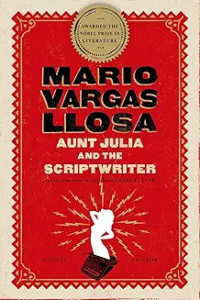
Aunt Julia and the Scriptwriter by Mario Varga Llosa 1977
I often know within a few pages whether I am in the presence of great writing or not. If not, I sometimes abandon the book, but will often press on hoping for improvement. In the case of “Aunt Julia and the Scriptwriter”, I knew within a page or two that I was in for a treat, a fine reading experience with a skilled writer. This book also passed my test for great fiction, the fact that I couldn’t wait to get back to it to find out what happened to the characters. As George Saunders wrote, the measure of good writing is to have the reader turn the page. I enjoyed turning each and every one of the pages in this fine book.
Llosa, who won the Nobel Prize in Literature in 2010 and almost every other honor available to a writer, died on April 13, 2025 at the age of 89. A fascinating man who combined a prolific writing career with a run for the presidency of Peru and an active life in national and South American politics, Llosa was honored in the Nobel tribute “for his cartography of structures of power and his trenchant images of the individual’s resistance, revolt, and defeat.”
When trying to determine which of his 20 novels, 18 books of non-fiction, and nine plays to read, I consulted the Guardian which has a series highlighting the Five Essential Novels of many 20th C authors. In this case, the Guardian’s #2 choice was “Aunt Julia and the Scriptwriter” and since I found that I already owned it on a shelf in Vermont, that’s what I read. I was not disappointed.
This comic novel set in 1950s Lima tells of a student and aspiring writer – Marito – who falls in love with his uncle’s sister-in-law, 13 years his senior. Marito also befriends a manic Bolivian scriptwriter, who’s producing soap operas daily for a local radio station where Mario writes the hourly news bulletins plagiarized from newspapers. It was only about one third through the book that I realized that every other chapter was a soap opera which alternated with Mario’s adventures with Aunt Julia. The book is often laugh out loud funny as poor Pedro Comancho, the Bolivian scriptwriter, descends in to madness and mixes up all of his soap opera characters and plots into confusing and hilarious combinations.
The book kept me engaged until the end when Llosa seems to have lost interest and wraps things up in a few not very satisfying pages. Nonetheless, this was a fine introduction to one of the giants of 20th C literature.

