
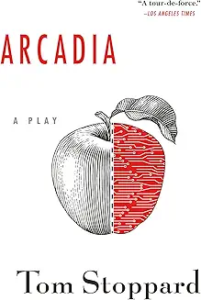
Arcadia by Tom Stoppard 1993
Stoppard’s “Arcadia” was written more than 30 years ago, performed first on Broadway in 1995 and then revived in 2011. It is now in revival again in London’s West End. It’s a brilliant exploration of free will, determinism, science, and human frailty and love.
The playwright sets the action in an English country house at two time periods with one set of characters in 1809 and another set of characters some 200+ years later in the present time. The two stories are continuously interwoven and even share the same stage in the final scene. The play opens in 1809 where a cynical, clever, and profligate tutor named Septimus Hodge is teaching his precocious young pupil, Thomasina Coverly in the grand English Sidley House in Derbyshire. Thomasina in the course of her ‘maths’ anticipates the outcome of Newton’s laws, i.e. that given enough computing power and a knowledge of current conditions, one can predict the future, but has neither the math skills or the computing ability to carry out her full idea. An unsuccesful poet and a few other characters provide secondary story lines.
The present day characters include Bernard Nightingale, an Oxford don pursuing a theory about Lord Byron, Hannah Jarvis, an author pursuing a story about the Sidley hermit, and the young lord of the manor, Valentine, who is wrestling with mathematical calculations relating to determinism and free will. Each are pursuing a thread that the 1809 story provides as the scenes flip back and forth between the two times.
The action is quick, and the dialogue is brilliant. Stoppard manages to bring it all together in the final scene when all the characters from both time periods are on stage, transitioning between the times with rapid resolution of the puzzles presented in the first act.
One can only marvel at the creativity of Stoppard who died late last year. Having seen “Rosenkranz and Guildenstern” many years ago and “Leopoldstadt” several years ago on Broadway, I’m eager to see a revival of this play with its clever banter and skilled execution by the playwright accompanied by deep questions about life, love, and our ability to know both the past and our own present. By the way, we are saved from determinism by the Second Law of Thermodynamics!
