
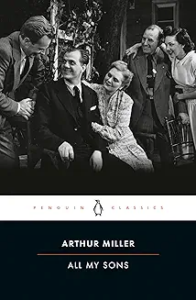
All My Sons by Arthur Miller 1947
Arthur Miller is considered one of the 20th C’s great playwrights along with Eugene O’Neill, Edward Albee, and Clifford Odets. This play precedes his better known “Death of a Salesman”, “The Crucible”, and “The View from the Bridge”, but is just as powerful and unsettling.
Miller’s personal life was just as newsworthy as his Pulitzer Prize and Tony winning dramas. Married to Marilyn Monroe from 1956-1961, he was also involved with the House UnAmerican Activities Committee. He was among 8 people named by the director Elia Kazan in 1952, the same Kazan who directed “All my Sons” when it opened on Broadway in five years earlier. Miller was subpoened by the HUAC and appeared in 1951 acknowledging his Communist Party affiliation, his American patriotism, and refusing to name names. He and Kazan never spoke again.
The play opened in 1947 starring Ed Begley and Karl Malden among others. In London and Broadway revivals stars such as Rosemary Harris, Laurence Olivier, Bryan Cranston, Tracy Letts, and Bill Pullman have appeared. The 2019 Broadway revival received three Tony nominations. It is now appearing in London’s West End, where we will see it in March.
To avoid a spoiler summary of the action, stop now, but for those interested, here’s the plot. The action takes place all in one day in the backyard of the Keller’s house somewhere in the Midwest. The Keller’s older son, Larry, has been MIA and presumed dead for three years in the Pacific theater of WWII. The younger son, Chris is living at home with his mother, Kate who refuses to accept that Larry is dead and with his father, Joe, the owner of a factory that made airplane engine parts during the War. Joe had been briefly imprisoned on charges that his factory had provided the Air Force with faulty parts that resulted in the deaths of 21 airmen. Joe was exonerated and released when he lied, blaming his plant manager, Steve Deever, for the lethal fraud. When Deever’s daughter, Anne and his son, George, arrive for a visit, the fragile house of cards of Joe’s lies and deceit comes tumbling down with fatal consequences.
The play is deeply disturbing and I read the ending somewhat in shock. Miller himself wrote that “The success of a play, especially one’s first success, is somewhat like pushing against a door which suddenly opens from the other side. One may fall on one’s face or not, but certainly a new room is opened that was always securely shut until then. For myself, the experience was invigorating. It made it possible to dream of daring more and risking more. The audience sat in silence before the unwinding of All My Sons and gasped when they should have, and I tasted that power which is reserved, I imagine, for playwrights, which is to know that by one’s invention a mass of strangers has been publicly transfixed.”
Transfixed, indeed, I was. The play’s themes of greed, money, family, memory, community, and the lies we tell to protect ourselves are highlighted in the tragedy of the Keller family—Larry’s and Joe’s suicides, the prison time of Steve Deever and its destruction of his family, and Chris’s loss of a brother, a father, and a wife. Lots to deal with when we see this drama in London!

