
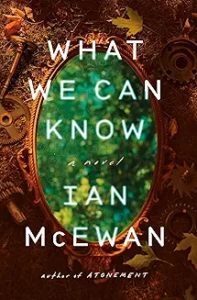
What We Can Know by Ian McEwan 2025
McEwan is one of England’s finest contemporary novelists with 17 novels and two short story collections published in the last several decades. Winner of the Booker, the Shakespeare, and the Jerusalem Prizes, The London Times named him number 19 among the top British writers since 1945. His stories are often macabre and offbeat, staying with one for quite some time. I’ve read six of his previous books finding ‘Atonement’ to be quite extraordinary. Evidently others did as well since it was made into an Oscar winning movie in 2007.
This is fascinating book filled with memorable characters and a clever, creative structure. Divided into two parts with different narrators and points of view, it proved to be quite effective. Part I opens in 2119 (yes, that’s not a misprint) one hundred years in the future. The world is still recovering from the Derangement and the Inundation. The Derangement referred to the insanity exhibited by world leaders who allowed the descent into nuclear war and its destructive consequences. When a nuclear bomb launched towards the US by China detonated over the ocean, tsunamis devastated the shorelines destroying coastal cities (NY, London, etc) and killing half the world’s 8 billion people.
We meet Tim and Rose, literary scholars, who are trying to discover a famous poem, “The Corona for Vivian” written by the eminent poet Francis Blundy for his wife, Vivian’s birthday one hundred years earlier and read to her at what was described as the Second Immortal Dinner. There was just this one copy of the poem, and it has been missing and the subject of many scholarly studies since then. Tim makes several trips to northern Scotland where a university library located high on a mountain to safeguard the papers from the flooded plains, keeps the Blundy archives. After many efforts, Tim and Rose finally find the solution.
Part two is narrated by Vivian and provides a real-time insight into the events that Tim and Rose had only been able to speculate about from a century later. We learn of her early loss of a child, her affairs with Francis and his brother-in-law, Harry Kitchener, her loving marriage to Percy, a lutier, and the frightening incident that will mark the last decades of her life.
This is ultimately a book about marriage, love, desire, and human relationships and the imperfect memory through which we view them in retrospect, though climate change, the failure of political leadership, and scholarly work come in for their criticism as well. The epigraph that introduces the book sets the tone quite well. It’s by Richard Holmes, one of my favorite biographers whose recreation of Robert Louis Stevenson’s journey through Europe is extensively cited by McEwan. “It concerns the kind of human truth, poised between fact and fiction, which a biographer can make as he tells the story of another’s life, and thereby make it both his own (like a friendship) and the public’s (like a betrayal). It asks what we can know, and what we can believe, and finally, what we can love.”
It is this truth about what we can know about others and about ourselves that McEwan appears to be after in all of his books. I very much liked this particular one, though I feel that to really own it, I’d need to re-read it with the current reading in mind. Might very well do so. In the meantime, you should read it.

