
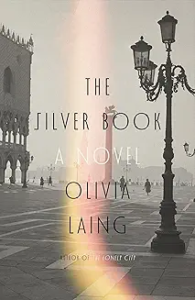
The Silver Book by Olivia Laing 2025
One of my favorite columns in the Sunday New York Times Book Review is ‘By the Book’ where a writer or celebrity is interviewed about their reading habits, favorite books of the past and present, and who they would invite to a dinner party. I ordinarily dismiss the interviews with singers, actors, musicians, etc mostly because I don’t recognize their name but also probably due my own snobby attitude towards literature and the authors who produce it; however, in a significant departure, an interview with Tilda Swinton last month yielded “The Silver Book” which she described as ‘the last great book’ she had read.
I probably would have dismissed this as well except the author is Olivia Laing, a writer whose prior books I had loved. I’ve read three of her non-fiction books, “The Lonely City”, “The Garden Against Time”, and “Funny Weather: Art in an Emergency”, and I thought each of them was spectacular. In his review of “The Garden Against Time”, A.O. Scott wrote of Laing, “She belongs in an as-yet-undefined and perhaps undefinable class of prose artists who blend feeling and analysis, speculation and research, wit and instruction as they track down the elusive patterns and inescapable contradictions of modern experience. If I were in an algorithmic mood, I’d mention Geoff Dyer, Teju Cole, Jenny Diski (who was married to Ian Patterson until her death in 2016) and W.G. Sebald”. Dyer, Sebald, and Laing—a trifecta winner!
This novel is quite a departure from her non-fiction works, though it shares with them her rich, lush , crystalline prose. The book was far from my usual ‘sweet spot’ for fiction. It takes place in Rome (a city I have only visited once and don’t know at all), focuses on Italian cinema of the 1970’s (ditto on not knowing it at all), and is very explicity homoerotic.
It’s a noirish mystery which begins with a suicide and ends with a violent beating death, and in between we experience the love affair between the 50ish costume designer Danieli and a 23 year old British waif. Laing, like Doctorow in “Ragtime”, mixes real life individuals with fictitious characters, real historical events with made up ones, and the result is a rich brew of plot, characters, and settings.
This book was not my cup of tea, but Laing’s writing and deft story-telling kept me moving ahead. Bottom line is that I’d read anything Laing writes but much prefer her non-fiction.

