
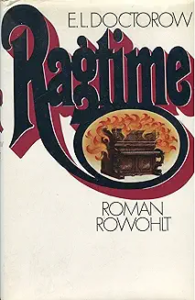
Ragtime by E.L. Doctorow 1975
Edgar Lawrence Doctorow who died in 2015 was the author of 12 novels, three volumes of short fiction, and a stage play. His works all included a rich mix of real historical figures and happenings and fictional characters and situations. A number of his works were adapted for the cinema and the stage, including this book whose stage presentation won four Tonys in 1998 and which is enjoying a successful revival on Broadway at this time.
Doctorow was much praised for his creative and innovative work and received three National Book Critics Circle Awards as well as a National Book Award and other prizes and recognition. “Ragtime” was named by the Modern Library as one of the hundred best novels of the 20th C.
My copy of this book has been sitting untouched on a top shelf in our bedroom for the 22 years we’ve lived in Cambridge and was somewhere in my library for the 30 years we lived in Newton, so I must have read it at least once during those years, but I had no recollection of the story until we saw the play at Lincoln Center last month. The production was spectacular and closely followed the book.
“Ragtime” takes place in 1906 a time of ferment in American cities and in the world. Immigration, poverty, unemployment, racism, urban sqaulor and violence, and income inequity were rampant and, not unlike our times, led to social tensions and oppression. The story focuses on three groups—the well-to-do White family living in New Rochelle—Mother, Father, Younger Brother, Grandfather and Little Boy; the dirt poor immigrant Latvian Jew Tateh and his daughter just off the boat; and a group of Negroes living in Harlem. The quiet, solid life of the New Rochelle family is turned upside down by the discovery of a Black newborn baby abandoned in their garden. The baby’s mother ultimately comes to live in their attic and introduces the family to the Black piano player Coalhouse Walker II, meshing two of the groups’ stories. Tateh, having become a successful movie director and his daughter meet the New Rochelle family in Atlantic City, tying all the groups together,
The stories of these families are interrupted a number of times by the introduction of Sigmund Freud and Jung, J. P. Morgan and Henry Ford, Harry Houdini, Emma Goldman, and the trio of Evelyn Nesbitt, Harry Thaw, and the man he killed, Sanford White.
This rich brew of real and fictional characters collide, ricochet, and finally explode in a violent ending. Tense and wonderfully written, this is a book worth reading and re-reading. Doctorow would be depressed but likely not surprised if he were alive today and saw the racism, anti-semitism, income inequality, immigration, and domestic violence that remain American 120 years after his book’s setting.
And, if you’re in NYC, see the play if at all possible.
(For those of you who are wondering who Roman Worholt whose name appears in large letters on the cover, I, too wondered. My copy published by Random House has no such name on the cover. The cover I found on the internet, must have been a copy from Europe since Roman Worholt is a German publishing company. Always interesting!)

