
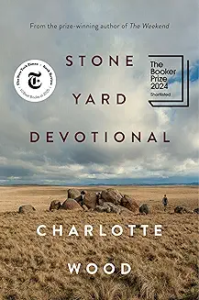
Stone Yard Devotional by Charlotte Wood 2025
This is a beautiful, lyrical novel, the seventh by this Australian writer. The Guardian’s reviewer referred to it as a “powerful and generous book.” It was short-listed for the 2024 Booker Prize and listed on the New York Times’ Ten Best Books of last year where I discovered it.
It’s a wonderful piece of fiction, a tale of despair and healing made universal by being suspended in a vague and unspecified time, place, and person. The book is written in the first person, but we never learn the name of the narrator. Similarly, the setting is a small town a six hour drive from Melbourne in the midst of an Australian landscape that is vast, dry, and flat, but we never learn the name of the town. Finally, it’s not clear when it takes place. There are computers and cell phones and numerous references to the climate crisis, but is it the present or the recent past. All of that lack of specifics feeds into the overall feeling of a languid timelessness and the melding of the personal into the universal.
We meet the narrator in the first chapter when she arrives at a small abbey in her home town in rural Australia. Visiting her parents’ graves there for the first time in 30 years, she settles into a spare guest house, taking her meals with the few nuns, witnessing their days of prayer and labor, and spending long hours lying on the floor thinking about her life. She is searching for a place of peace as her marriage is coming to an end, and she finds it among the nuns with their simple and isolated world of faith. The second chapter five years later finds that our narrator has left her job and her home in the Sydney suburb where she had lived, has unsubscribed from all her organizations, and has adopted the quiet, simple life of the abbey as her full time home.
Not much happens. Actually nothing happens. As the Guardian reviewer wrote, “This probably does not sound like the most spine-tingling premise for a book, but I have rarely been so absorbed, so persuaded by a novel. Also, I haven’t yet mentioned the mice.” The plague of mice fleeing the drought to the north, the return of the bones of a murdered nun who had lived at the abbey, and the return of an unhappy girl from her childhood now grown into an activist nun disrupt the quiet contemplative life, but they don’t destroy it.
Memory, life experience, and purpose are the main characters in this quiet, deeply thoughtful, and moving novel as the narrator finds time and tranquility to review her life choices, to rue her past neglect of parents and friends, and to find resolve for a simpler, more focused life.
I highly recommend it.

