
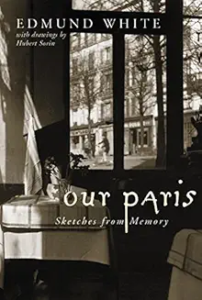
Our Paris: Sketches from Memory by Edmund White 1994
Edmund White (born January 13, 1940-died June 3, 2025) is a fascinating character, often credited with being the first major writer to identify as a gay author and to consistently promote other LGBQ+ writers when being gay was still a taboo. Becoming active after the Stonewall Riot, he wrote novels, short stories, memoirs, and biographies bringing gay issues to the public in a forthright and non-sensational manner.
His career spanned long periods living in Paris and New York where he wrote and was associated with major literary and cultural figures. His achievements were honored with Lifetime Achievement Awards from the National Book Foundation and the PEN/Saul Bellow Award. His biography of Jean Genet was nominated for a Pulitzer and received the National Book Critics Circle Award in 1993.
White wrote “Our Paris” at the height of the AIDS epidemic, penning the final chapter within hours of the death of his lover of five years, the French architect and artist Hubert Sorin in Marrakesh in March, 1994. White himself had been HIV positive since 1985 but had non-progressive disease and lived to bury and write about many friends. This slim volume came about because as White wrote, “So many of my friends with AIDS have wanted to write a book or make some other kind of work of art to celebrate or at least mark their passage on earth and in time. Few of these ambitions have been realized, either because illness has interfered with their execution or because the world (or the marketplace) has taken no interest in their efforts….What kept (Hubert Sorin) alive was the idea of finishing this book.”
The book is a series of portraits in White’s words and Sorin’s sketches of Parisian characters, from their concierge in the Chatelet to famous performance artists and gay creatives. The title is derived from Sorin’s refusal to work from photographs or live models, but only from memory. Sadly, the portraits are quite dated and unless one is a deep lover of Paris in the 1990’s and its writers, artists, actors, and dancers, the name-dropping (which White candidly embraces) goes by without much recognition.
Nonetheless, the book accomplishes what so many others fail to do–it freezes time in an era that will never return, one that the cell phone, the internet, and the big box stores have erased in Paris as they have in the U.S. I loved wandering the streets of Paris with White as he penned this love letter to a city and a lover that are no more.
Edmund Valentine White III died in New York City at the age of 85 with his husband of 12 years by his side.

