
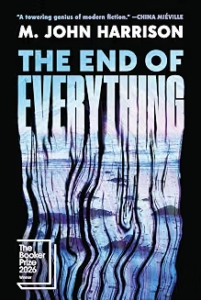
The End of Everything by M. John Harrison 2026
I don’t read much science fiction but when this book was listed among the best sci-fi reads of the year by the NYT, I put it on “Hold” at the Cambridge Public Library. So did several hundred others. It was only when I began writing this review that I found out that it had won the 2026 Booker Prize in the interval and hence, its popularity.
The NYT review post-Booker begins with this description of the book, “fascinating, sometimes frustrating and thoroughly original”, and I couldn’t agree more, especially with the ‘frustrating’ part. I have increasingly become comfortable with a DNF, i.e. ‘did not finish’ policy, and I will drop a book if it’s boring, dumb, or poorly written. I was tempted several times to do so while reading “The End of Everything”.
It’s not boring (though it comes close at times), dumb (though I was frustrated with the author’s cuteness about the basic event underlying the plot, i.e. the invasion by aliens), and it’s certainly not poorly written. In fact, it was the author’s writing skill that kept me at it. Here’s an example, “Viewed from up there, the cove lay undecided about itself or its offer to the passing trade.” Time and again, Harrison grabbed me with a beautiful sentence, phrase, or paragraph. The NYT reviewer agreed with me when he wrote, “….it conjures images and narrative tones that will not apply to this book, a masterly exercise in restraint, unsettling beauty and elliptical writing that can enlighten even when it obfuscates.”
The story itself, however, not so much. We are plunked down on the southeast coast of England at some indeterminate time after London’s Square Mile has been laid waste by an alien invasion that is referred to as the disaster, the catastrophe, the chaos, but not otherwise characterized. The Ighetti have arrived from outer space but it’s not clear who or what they are, what they want, or what their impact has been beyond the endless war in London. Harrison’s characters, Phillip Tennant, his aunt Marnie, and the ‘artifact’, an unformed Ighetti which Phillip has found on the beach, lurch through time as death and destruction intervene daily.
I’ll quote again from the NYT review: “In fact, very little is clear in this book, which deals in shifting realities and the volatile nature of selfhood. Reading it can feel like working on a jigsaw puzzle with a picture that keeps changing, wondering all the while if stray pieces have fallen in from another box.” Great summary!
“The End of Everything” is the first sci-fi book to win The Booker and for that, Harrison is to be congratulated, but unless you’re a hard core sci-fi fan, I’d give this one a pass.

