
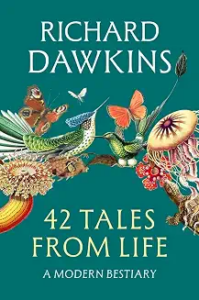
42 Tales From Life: A Modern Beastiary by Richard Dawkins 2026
The 85 year old Dawkins is one of the most influential science writers of our time, tirelessly and effectively making the case for Darwinian natural selection via the gene as the force for complexity in this world and denying the existence of the God at the center of creationism.
I loved his previous book, “The Ancestor’s Tale” in which he used the model of Chaucer’s “Canterbury Tales” to explore the evolution of life beginnig with today and working backwards to explore our original common ancestor, the beginning of life on earth approximately 4 billion years ago. In “42 Tales From Life” he continues that exploration of complexity driven by natural selection using the model of a medieval beastiary, a compendium of animal illustrations. But while those from the 12th C featured mythical creatures, Dawkins’ beastiary features real animals which Dawkins describes in often excruciating detail before drawing a Darwinian lesson or moral from each story. As he writes, “Reality goes beyond what we can easily imagine, goes far beyond the troubled fantasies of the old beastiarie and challenges science-fiction writers to come up with something even more alien.”
The thread that ties these 42 tales together is the “beautiful and meticulous biological art of the celebrated German zoologist and artist Ernst Haeckel, (1834-1919) known as the German Darwin …. whose microscope revealed wonders to outdo the wildest imagination.” Each tale begins with the Haeckel drawing or painting that inspired it, one of the roughly 3000 he created and a subset of the 100 included in his book “Art Forms in Nature”.
“42 Tales” could be maddeningly recondite at times, but overall was worth the time to read. It rekindled the excitement and awe I recall from my childhood when I visited the Museum of Science and Industry in Chicago or read a book about biology. As Dawkins wrote, you just can’t make this stuff up, and it’s all incredibly true! Some of the writing is downright impossible to sort out and understand, but all of it is fascinating.
One example that I loved is Tale 23, The Slime Mould’s Tale in which Dawkins recounts the experiment done in Japan when researchers set up a maze in a Petri dish. They placed Physarum (i.e. slime mould) on the surface and then ‘hid’ its favorite food, oats, in two places in the maze. Over time, the slime mould discovered the oats and abandoned blind alleys. Another experiment tested slime mould’s ability to identify the optimal routes for the Tokyo train system and its solution to the Travelling Salesman Problem. In both cases, the “lower” life form without a brain confirmed the solution humans had come up with.
I’m a little doubtful that a non-scientist would enjoy working through some of the often complex and difficult passages that are scattered through the 350 pages of this book. Haeckel’s illustrations, however, are worth the journey by themselves. Dawkins doesn’t disappoint in his commitment to Darwin, genes, and natural selection as he completes a distinguished career of writing and teaching.

