
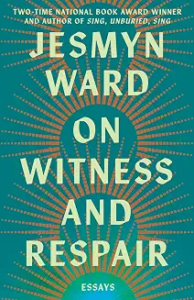
On Witness and Respair by Jesmyn Ward 2026
This is a remarkable book, exquisite in its language and style and shockingly unsettling in its content.
Ward, a MacArthur genius grant recipient and the 2022 winner of the Library of Congress Prize for Fiction, a two-time National Book Awardee, and a finalist for a National Book Critics Circle Award, is a professor of creative writing at Tulane and lives in Mississippi.
She grew up poor in the bayou country of segregated southern Mississippi, living along with as many as 14 relatives in her grandmother’s house, eating beans and rice, and listening to the stories told by her grandmother, mother and aunts about the impact of 400 years of hate and dehumanization in the South. With the support of a wealthy white woman whose house Ward’s mother cleaned, she attended a private school where she was the only Black student and went on to Stanford for her AB and MFA. Returning to Mississippi, she couldn’t find a job, lived in NYC and Los Angeles, lost her 13 year partner to COVID, and moved back to Mississippi with her two children to live, write, and bear witness to the ongoing struggle for Black people’s ‘worth’ in today’s America.
In this collection of 22 essays written between 2008 and 2025 and ranging from the introductions to new editions of James Balwin’s “A Fire Next Time” and Faulkner’s “As I Lay Dying”, to a eulogy she gave at Toni Morrison’s memorial and from magazine articles in Time, Harper’s, Guernica, Vanity Fair, Smithsonian, and The Atlantic to named lectures at The Library of Congress and the National Press Club, Ward has been a powerful voice for Black Art and Black worthiness.
Ordinarily I would have reacted negatively to the repetition of many stories and characters that occupy these essays, but in Ward’s case, the repetition served to sear these images, stories, and people into my brain. The death of her brother when a drunk white man hit his car and went unpunished; the death of her partner in the early days of COVID; her own stories of experiencing hate and terror from her childhood—-these are the things that keep Ward responding to her grandmother’s urging to tell it all and tell it again and again. And she does so with enormous energy, compassion, and commitment. She found reading to be her escape and safe place when a child, and she has now committed to writing to provide that opportunity to others.
I misread the title of this book several times, seeing “despair’ instead of the archaic ‘respair’ which means fresh hope and recovery from despair. It’s a writerly touch and evidence of the wisdom and creativity inside its pages.
Every American, black, brown, white and every other hue should read this book to feel the shame and sorrow that we have caused to our fellow Americans and to understand how the world must be changed so that no young child feels the ‘blood dread’ that Ward did. The tide is running the other direction today, but as MLK said, the arc of justice slowly bends in the right direction. Read Ward!

