
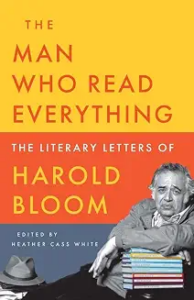
The Man Who Read Everything: The Literary Letters of Harold Bloom ed. by Heather Cass White 2026
While spending a leisurely day walking around Lenox, MA last month, we stopped to browse in the The Bookstore and chat with its owner, Matthew Tannenbaum. The store and Matt had been featured in a wonderful movie, Hello, Bookstore in 2022. As is my practice, I always try to buy a book when visiting an independent bookstore, and this book about Harold Bloom’s literary correspondence caught my eye and came home with me.
I’ve been fascinated with Bloom for decades, a love affair that began when I first read his book, “How to Read and Why” published in 2000. The book which provided both the rationale for widely reading as well as a list of his recommended novels, short stories, poems, and plays provided me with the early groundwork for what has become BookMarks. A professor at both Yale and NYU, Bloom was the foremost literary critic of the latter part of the 20th C. and the early years of the 21st C. He wrote more than 50 books, innumerable articles in literary journals, and edited over 100 anthologies. He was a staunch defender of the Western Canon railing against deconstruction as a critique and later the —isms that threatened his precious canon. He loved controversy and was frequently in the middle of literary conflicts which were often violent because the stakes are so small.
Nonetheless, I loved his “How to Read and Why” and have gifted it to a number of friends and young family members. I’ve also read his “Anxiety of Influence” which may be his most lasting gift to literary criticism with its theory that all poets are battling to exceed their forebears. I also found his “Til I End My Song’ to be a moving collection of the final work of 100 dead poets from Lucretius to Ashbery.
Despite my fondness for this grumpy and erudite critic, I found this book of his literary correspondence to be, perhaps, the biggest slog of my recent years of reading. The letters exchanged between Bloom and Alvin Feinman (a close friend but a failed poet), Northrup Frye (a Canadian literary critic and mentor to Bloom), John Hollander (a friend and colleague at Yale from a young age), A. R. Ammons and John Ashbery (considered by Bloom to be the two best poets of his generation), and James Merrill were boring at best, and sleep inducing at their worst. Bloom’s annoying lack of self-confidence, praising and kissing up to the poets, his endless moaning and groaning about poetry, editors, fellow poets, the reading public, and the minutia of this or that poem tested my commitment to read to the end, and then voila!, the final group of letters made it all worthwhile. Bloom at 87 and Ursula LeGuin at 88 had never met but began a charming and caring exchange of letters two years before both died, and those letters were warm, interesting, informative, and exciting, in short, grand!
The final letter in the book was written by Bloom to LeGuin on January 23, 2018 in which he wrote that he had taught Hamlet that morning and had finished “Possessed by Memory” and had begun his final book, “The Lost Traveler’s Dream”. In that book he planned to discuss 25 novels that he wanted to re-read before he dies. Sadly, a footnote informed me that LeGuin had died the morning he wrote that letter and Bloom himself died 18 months later. I cried reading that.
The bottom line on this book is that it’s really intended for those engaged in the very highest level of academic criticism. Bloom’s heroes of the past, Shakespeare, Johnson, Emerson, Pater, all make an appearance, and his love of lists is evident in his repeated list of favorite poets, Ashbery, Ammons, Stevens, Merrill, Bishop, Swenson, Hollander, Merwin, Wright, Strand, and Warren. Read his other books; read these poets; but unless you struggle with insomnia, give this one a pass.

