
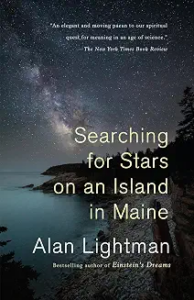
Searching for Stars on an Island in Maine by Alan Lightman 2018
I read this book when it was published in 2018, book #2393 in my Book Journal, and here, nearly 1000 books later, I found it to be just as interesting. Herodotus is famous for allegedly saying that you can never step into the same river twice, and re-reading has often been discussed in a similar framework. The words may be the same but you are definitely different, and in the case of Lightman’s book, I find that my review from 8 years ago was a bit too harsh. In fact, the criticism that I levelled at him is what I found to be the book’s main strength this time around—the layman’s informed take on quantum physics, cosmology, consciousness, and free will.
Recent BookMarks’ updates have dealt with all of these topics, so it was refreshing to re-read Lightman’s take on them. As a physics PhD and a teacher of writing at MIT, he’s the perfect person to put together the humanities and science of these topics. I’d love to hear him speak about the changes that the last eight years have led to in both science and his thinking about his ‘search’. It was particularly meaningful to read the book while on the coast of Maine, probably not too far from the island which he cited in his title.
Here’s the review from 2018: Lightman, a physicist, writer, and professor of the practice of the humanities at MIT, has written an interesting book about the separate heuristics and thought systems of science and religion and how they interact or fail to do so. Lying on his back on a moss covered rock on a small island off the coast of Maine where he and his family have enjoyed many summers, he finds fascination in the immensity of the universe as seen in the myriad stars in the night sky as well as in the minutia of plants and insects in a square inch of land he examines closely. Citing Bruno, Galileo, Kepler, Newton and more recently Einstein, Planck, and contemporary cosmologists and astrophysicists, he contrasts the Absolutes of Science’s Central Doctrine (i.e. truth can be tested, independently verified, and stated unequivocally in mathematical terms) and the Absolutes of religion which must be taken on faith since they cannot be proven. He also contrasts the vitalists who believe in a soul, an immaterial essence that separates man from the rest of the world and the mechanists who view man as a complex system but one that comprises the same atoms, molecules, and chemistry that are identical to those in the rest of the universe. Lightman’s goal is admirable and he partially succeeds, but he too often drifts off into saccharine and treacly language and phrases. Had he kept it more serious and focused, this could have been a far superior book, but as it is, it provides a gentle introduction to many of the controversies that have separated humans for centuries, e.g. Aristotle vs Augustine, Trump vs the rest of the educated world.

