
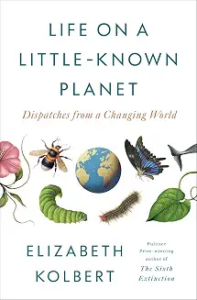
Life on a Little-Known Planet: Dispatches from a Changing World by Elizabeth Kolbert 2025
Kolbert has been a staff writer at “The New Yorker” since 1999 and is our time’s leading writer about the ecological challenges facing the earth in this what has come to be called the Anthropocene Age, a unique period in the history of the earth when man himself is changing the very natue of the planet.
This volume comprises 17 of her New Yorker articles which originally appeared from 2005 to 2023. Each one dives deeply into fascinating and often esoteric topics as varied as attempts to interpret sperm whale language to the disappearance of the Eyak language of Alaska, from collecting previously unknown species of caterpillars in the Chihauhan Desert to a scientist using DNA from elephant dung to identify ivory poachers, and on and on. Kolbert’s modus operandi is similar to that of another of my favorite essayists, John McPhee. She identifies an expert in an interesting field, forms a relationship with that person, and then spends considerable time with him/her in the location in which they work, in this case from Greenland to Alaska, from Tanzania to Mexico, from Costa Rica to Miami. She then writes a brilliant description of an often complex topic. With great insight, fine language, clever humor, and lots of data, these are brilliant essays which should give all of us deep concern for our planet and its residents both human and other.
Whether you’re a scientist or a casual observer of the biology of our world, Kolbert makes for great reading. One drawback of this book, however, is that even the most recent essay has been rendered out of date and those that were written nearly 20 years ago are almost irrelevant in our rapidly changing world. Kolbert has attempted to address this issue by including a very brief, italicized update at the end of each chapter, but given her own sense of the complexity of these issues, she must have sensed the inadequacy of that effort.
I would have loved to see each original essay paired with another similarly detailed update, but that would have required a similarly extraordinary effort on Kolbert’s part, and she has, I’m sure, already moved on to new and important topics. Given this limitation, read this book to learn and to share her concern for the fragility of our home planet that we seem determined to destroy. You’ll also find some very funny and vivid metaphors that highlight her concerns. For example, in writing about the tremendous loss of water in Lake Powell due to climate change, Kolbert points out that the volume of lost water would cover Massachusetts to a depth of 140 feet!
My prediction is that Kolbert’s book will be read in the future as a profound warning about man’s destruction of planet earth, from the elimination of life forms from the caterpillars that we haven’t even discovered, named, and studied to the elephants who are being murdered for their ivory. Her essays about climate change will be viewed as accurate predictors of the dire futures that many will face. Read this book and become outraged.

