
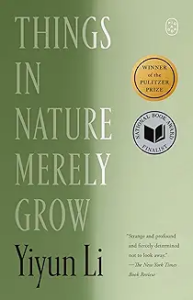
Things in Nature Merely Grow by Yiyn Li 2025
This is one of those books that upon finishing, I felt the need to immediately read it again. This surprised me because I had come close to dropping it after a dozen pages or so. It was and remains a tough read, not due to the writing which is quite beautiful and not because of the content which is brilliantly presented, but because of the subject matter.
Li, one of the best novelists and essayists writing today from her role as a professor of creative writing at Princeton, wrote this book as a way to understand two catastrophic events in her life, the suicide of her 16 year old son Vincent in 2017 and the suicide of her 19 year old son James in 2024. I have often thought that if one of my daughters committed suicide I would climb into bed and never emerge. Li, too, is tempted by this approach referring to it as ‘her abyss’, rejects it, and then writes with sadness, self-compassion, and deep insights into how she continues to deal with her reality every day.
The book’s unstated framework appears to be one of dualities. The cover itself is divided into two halves, one side a deeper green than the other, and this duality charactrizes much of Li’s commentary. Intuition/facts, reality/unreality, life/death, attention/indifference, time-bound/timeless are some of those relationships that she explores as she introduces her reader to her sons and speculates on why they chose to end their lives rather than continue to experience the pain of existence.
Li, herself the survivor of two suicide attempts which led to a psychiatric hospitalization in 2012, adopts ‘radical acceptance’ as her approach, rejecting the labels of ‘grieving’ and ‘mourning’ since they imply a time-limited process, and she has adopted a daily remembrance of her sons that will continue for her whole life. She describes her days as containing “the absoluteness of life (that means) that in each day, time has to be marked before the next day arrives.” She finds solace and a model for her sadness in gardening where “things go wrong more often then they go right”, and she finds writing to be helpful and engaging, not as a way of forgetting or moving on, but as a way of dealing with what she refers to as “Now and Now and Now and Now”. She refers to living ‘alone in her personal abyss‘ and uses the Myth of Sisyphsus and Camus’s eponymous book as a paradigm for dealing with her sadness, a boulder among the daily pebbles that often distract us.
Her characterizations of her sons, Vincent as feeling and James as thinking, are powerfully and lovingly drawn, and she makes every attempt to understand their actions with respect and care. Her concluding paragraph reads as follows: “Sometimes a mother and a child are like two hands placed next to each other: only just touching, or else with fingers intertwined. Then the world turns, and one hand is left, holding on to everything and nothing that is called now and now and now and now.”
This marvelous and powerful book, recently named the winner of the 2025 Pulitzer Prize for Autobiography, was a compelling though not easy read. I read two thirds of it in one sitting and found that I was largely lost in the flow of the narrative, a too-rare but precious experience.
Even, if like me, you can’t fathom the loss of two children to suicide, read this book for its insights into parenthood, humanity, and the unique characteristics that our children bring to life.

