
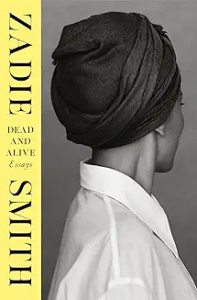
Dead and Alive: Essays by Zadie Smith 2025
Smith is one of contemporary England’s most influential and productive writers with six novels, two short story collections, a play, and three books of essays. She is an exceptionally fine writer, and a brilliant observer of our current world.
“Dead and Alive: Essays” collects 30 essays published originally between 2016 and 2025 primarily in The New Yorker and The New York Review of Books. They are grouped into five sections, “Eyeballing” (reviews of art exhibitions and movies), “Considering” (three wonderful essays about writing fiction, living in NYC, and time), “Reconsidering” (essays about contemporary political topics including race, immigration, fascism, and Kara Walker), “Mourning” (five essays written as obituaries or eulogies for Joan Didion, Toni Morrison, Philip Roth, Martin Amis, and Hilary Mantel), and “Confessing” (a random collection of thought pieces).
My favorite among these essays are the ones that focus on her writing, especially the challenge and satisfaction of writing fiction. In her essay, “Fascinated to Presume” she takes on the contentious issue of whether a writer can create characters that are fundamentally different from his/herself, i.e. could William Styron legitimately writer about Nat Turner? Balancing the opposite arguments of containment and presumption, Smith makes the strong case that what is evident on the outside (i.e. race, gender, national origin, religion) is not the most important factor in determining who is a legitimate writer of fiction. She write “Fiction suspected that there is far more to people than what they choose to make manifest. Fiction wondered what likeness between selves might even mean, given the profound mystery of consciousness itself, which so many other disciplines have probed for millenia without reaching any definitive conclusions….Fiction—at least the kind that was any good—was full of doubt, self-doubt above all. It had grave doubts about the nature of the self.”
Doubt seems to be the primary characteristic of most of these works. Smith, born to a Jamaican mother and English father, and brought up in Willendon, a rather poor, immigrant community in North London, went to her local schools before she embarked for Cambridge and her posh education. As a mixed race child with a parent from a colonialized West Indian island, she brings plenty of worldly experience with being ‘the other’ to her work.
Whether reviewing a film or a rap concert, commenting on the destructive actions of the Tories and Trump, or delving deeply into the arts (There’s a wonderful section on Celia Paul’s paintings.), especially the writing of fiction, Smith exemplifies the value of the personal essay as she ‘tries’ to explore her own reaction to these events and questions in order to clarify her thinking for herself and her readers. I loved her debut novel, “White Teeth” and now this collection of her thought pieces on contemporary issues.

