
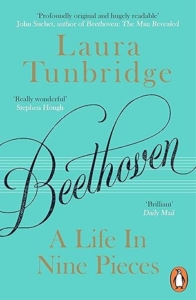
Beethoven: A Life in Nine Pieces by Laura Tunbridge 2020
The story of how I found this book is almost as interesting as the book itself.
While enjoying our month in London in 2025, we attended a fascinating performance in the Queen Elizabeth Hall on the South Bank. A group of actors and musicians performed a program that explored Edward Said’s book On Late Style, a book which I had read and relished a number of years earlier. Said explored how great artists adapted their works as they approached their final years.
Among the works explored were those of Beethoven’s late style, his late string quartets and Missa Solemnis. While the orchesta played selections from these works, the actors spoke the words of my favorite Harvard/The New Yorker critic, James Wood. Wood had written an article about the late Beethoven in the New York Review of Books, and the words that accompanied the music were drawn from that article. When I read the full NYRB review, I found that one of the books Wood cited was this one by Laura Tunbridge. This month, I finally got around to reading it.
It’s a creative take on the art of biography. Tunbridge weaves Beethoven’s life from his birth in Bonn in 1770 to his death outside Vienna in 1827 into the music he was writing at various stages of his life. Starting with the Septet, op. 20 in 1800 and continuing through the Kreutzer Violin Sonata op. 47 in 1803, the Eroica Symphony #3, op. 55 in 1804, the Choral Fantasy op. 80 in 1808, a song “An die Geliebte” from 1812, Fidelio op. 72 in 1814, the Hammerklavier Piano Sonata no. 29, op. 106 in 1818, Missa Solemnis op. 123 from 1823, and finally the String Quartet, op. 130 from his final year, Tunbridge analyzes the music, the conditions under which each work was written, and the important events in Beethoven’s life at that time.
The pleasure of listening to these pieces while reading the book enhanced the experience, especially since all of them were easily accessed via You Tube providing a variety of artists and orchestras for each work. Beethoven was an enormous presence in the early 19th C world of Vienna, London (which he never visited), and all of the Europe that was constantly undergoing war and realignment of borders during the Napoleanic era. The book provides an interesting view of Beethoven the businessman selling rights to his work to noblemen and publishers, living close to the edge financially while breaking all the rules and boundaries for music. The stipulation in his 1809 contract with four noblemen that assured him of an annual stipend carried with it the requirement that he stay in Vienna and only travel with their permission—shades of the current Boston Symphony Orchestra conflict with their principal conductor.
While I remain sadly deficient in understanding the language of music and much of the book was lost on me, I did come away with a greater appreciation of Beethoven’s genius and how radically his late music departed from the current conventions.

