
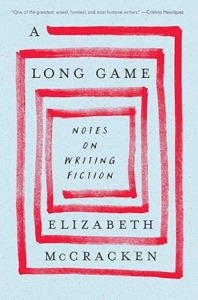
A Long Game: Notes on Writing Fiction by Elizabeth McCracken 2025
I’d love to sit over a cup of coffee and a cheese danish with Elizabeth McCracken and just chat for a couple of hours. I’m also quite sure I couldn’t be in her workshop class at the Iowa Writer’s Workshop where taught fiction writing for many years or at the University of Texas where she’s the James Michener Professor of Fiction—it would be too scary, pressured, frustrating and all of that would be due to me and my insecurities.
I found this book on the ‘to be shelved’ cart at the Cambridge Public Library, and loved every one of its 201 pages. They’re organized into 280 numbered bullets, some as brief as one sentence and some as long as several pages, and the bullets are organized into ten Roman numeraled chapters, though the latter have no titles so it’s hard to know why they are there.
Bottom line, however, is that McCracken, the author of nine books of fiction, has turned out what she vowed to never write—a ‘how to’, craft book about writing fiction, and it’s a beauty, Funny, ironic, honest, blunt, and probably incredibly useful for the aspiring writer, I found it to be a delight. She describes her teaching role despite her lack of academic training: “it’s like an amoeba teaching in a biology lab.”
Though I’ll never write fiction, I find the act of doing so to be completely fascinating, as does McCracken. Here’s her take on creating characters: “What happens when inner life meets outer life? That’s the most interesting question in fiction, It’s also the most important part of human existence.” And then there’s this nugget of advice about travel for young writers: “Apart from reading there is no better training for being a writer than travel…mostly it takes you out of your own context. Dislocation is helpful to a fiction-writing brain.” And here’s a great description of one of her favorite recommendations, i.e. to revise, revise, revise with the caution about when and how to do it. “Writing a novel is like carrying a pile of clean laundry in your arms, cumbersome, fragrant, you’re impressed with your own efforts. Then you drop a sock. Should you bend down to pick it up? No: you risk dropping your entire armful. You’ll remember the sock is there; you can get it later.” How great is that!
What makes this slim volume so delightful, at its most basic, is McCracken’s offbeat and wry sense of humor. In a section where she urges writers to not learn the quantitative measures of another writer’s career such as advance or sale figures she writes: “Once I learned that a writer I greatly respected had sold fewer than three hundred copies of his well-reviewed book. It was like seeing a picture of him in his underwear.” There are dozens of examples of these very funny observations.
At the end of the day, I loved this book because while McCracken is advising students on how to write great fiction, she wrote a great book herself. (As an aside, I always read the Wikipedia entry about a writer after I’ve finished the book and usually after I have written my review, as I did in this case. I learned with pleasure that McCracken had grown up in Newton where we raised our daughters, went to Newton North High School as one of our girls did, and then Boston University. A local girl!).

