
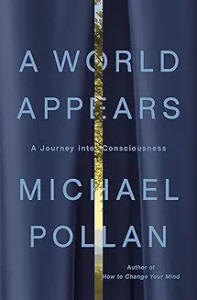
A World Appears: A Journey into Consciousness by Michael Pollen 2026
This is both a remarkable and a challenging book. Pollen, who has written 10 previous books on topics as varied as psychedelics and veganism and who is a professor of journalis at Berkeley has taken on the difficult and complicated task of exploring consciousness and the attempts by neuroscientists and philosophers to explain it and its origins.
His journey takes him all over the globe (often via Zoom) to talk with individuals engaged in trying to solve the “hard problem” a meme introduced by David Chalmers, an Australian philosopher, in his 1998 bet with Christof Koch, a young associate of the famous DNA scientist Francis Crick. Koch’s wager was that “within 25 years scientists would discover the physical footprint of consciousness in the brain, a small set of specialized neurons responsible for subjective experiences.” Koch lost that bet.
Nearly 30 years later, science and philosophy continue to explore how a relatively small lump of grey tissue lodged in our skull can produce ideas, thoughts, feelings, and the sense that we are here, in other words, how the brain can do everything involved in the sense of wonder when “a world appears” every morning when we open our eyes.
One of the individuals who Pollen interviews is a British physicist, neuroscientist, and psychiatrist named Karl J. Friston whose work focuses on the elemental question of how any kind of complex system (e.g. the human body, brain, and consciousness) survives in a universe governed by the second law of thermodynamics, i.e. entropy and increasing disorder. Pollen describes Friston’s papers as ‘impenetrable”, and I found much of Pollen’s book to be so as well. This is complicated, difficult, and often intangible stuff. Pollen, himself, writes towards the end of the book that “I find myself not at all sure what to believe, if anything.I’m abashed to say I know less now than I did when, naively, I set out to unravel the mystery of consciousness.” He had explored experiential or descriptive approaches including phenomenology, literature, psychadelics, hypnotism, and meditation as well as all kinds of materialist, scientific approaches, but none of them had fully explained the awareness that we humans have of our mortality and being.
The final chapter relates his experience in New Mexico where a Buddhist meditator provides him with a five day solo retreat during which Pollen lets go into “unknowing” and finds some answers by being ‘present to life’. He concludes the book with “Consciousness is a miracle, truly and remains the deepest of mysteries, yes, but it is also so very simple it can fit into a sentence. I open my eyes and a world appears.”
I’m ambivalent about this book. It’s fascinating and interesting and provocative, but it’s also frustrating and often difficult to follow the names, arguments, and conclusions as he explores many of the 22 current theories of consciousness, including panpsychism (everything including grains of sand is conscious) and idealism (consciousness exists throughout the universe, like gravity). In one of the most interesting sections of the book, Pollen takes a serious look at whether robots and AI will eventually include feelings and self-awareness and, therefore, require us to include them in our moral equations.
Bottom line for me is that if you are one who wonders about wondering, this is a book for you. For those content to just be happy to wake up in the morning, as I am, you will probably get more pleasure from a Simenon mystery. .

