
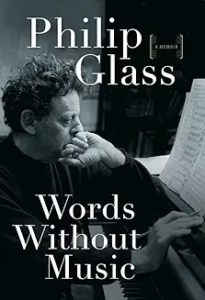
Words Without Music: A Memoir by Philip Glass 2015
I had known Glass’s name for years though I could not have told you anything about him except that he’s a composer of contemporary music. Somehow, his 2015 memoir in hard cover had found its way onto my bookshelf, and on a whim one day, I began to read it. After a page or two, I was hooked and couldn’t put it down.
Glass is a fascinating character who in addition to being the most prolific and creative composer of our times is also a fine writer. This memoir meets the two criteria for excellence: a fascinating person who wrote a fine book.
Born in Baltimore in 1937, one of three siblings in a Jewish family, he was an independent thinker from an early age. Introduced at an early age to music at his father’s record store, he studied piano and flute at the Peabody Institute before beginning college at age 15 at the University of Chicago. After graduation, he studied composition and piano at Julliard and soaked up the NYC jazz scene before heading to Paris on a Fullbright to spend three years with Nadia Boulanger learning the basics of musical language. After three years of weekly, intensive work with her, he was ready to develop his own musical language and traveled with his new wife overland to Tibet and India in his late 20’s. This began a pattern of travel, building relationships, discovering new musical languages, and incorporating all of that into his own unique style based on rhythm, harmony, and meldody. His music was influential in the accceptance of world music into Western works, including traditions from India, Gambia, Brazil, and indigenous Mexico, all of which he visited and studied. He describes his work as additive, subtractive, obsessive, and repetitive, characteristics that often led critics and audiences to disdain his work. His relationships with some of the great minimalist and conceptual artists of the time, Richard Serra, Donald Judd, Sol Lewitt when they were also young had a profound influence on his work which he also considered conceptual. He was also heavily influenced by writing music for plays by Samuel Beckett and later Leonard Cohen’s poetry.
His first concert in NYC took place in a school in Queens in 1968. The crowd of six included his mother. Eight years later, the Metropolitan Opera sold out two performances of “Einstein on the Beach”, and a phenomenal career in musical composition had been launched. He has written 15 operas, numerous chamber operas and musical theatre works, 15 symphonies, 12 concertos, nine string quartets, various other chamber music pieces, and many film scores. He has received nominations for four Grammy Awards, including two for Best Contemporary Classical Composition for Satyagraha (1987) and String Quartet No. 2 (1988). He has received three Academy Award for Best Original Score nominations for Martin Scorsese‘s Kundun (1997), Stephen Daldry‘s The Hours (2002), and Richard Eyre‘s Notes on a Scandal (2006). He also composed the scores for Koyaanisqatsi (1982), Mishima: A Life in Four Chapters (1985), Hamburger Hill (1987), The Thin Blue Line (1988), Candyman (1992), The Truman Show (1998), and The Illusionist (2006). He also wrote the scores for several Broadway revivals including “The Crucible” and “King Lear”.
One of the most interesting aspects of Glass’s life is that while writing some of the world’s greatest music, he supported himself (and at one time or another his four wives) with blue collar labor. He worked as a mover using a friend’s truck, a self-taught plumber, and drove a cab for many years until his music was able to support him. Another fascinating aspect of this complex man is his ability to form friendships with a wide variety of people from Doris Lessing to Alan Ginsberg, Woody Allen to Steven Colbert, Ravi Shankar to Richard Serra. Another interesting element is his attachment to his second home in Cape Breton, Nova Scotia where he has summered for many years.
In a final chapter labelled Closing, he repeats this quote several times: “OPENINGS AND CLOSINGS. BEGINNINGS AND ENDINGS. Everything in between passes as quickly as the blink of an eye. an eternity precedes the opening and another, if not the same, follows the closing. Somehow everything that lies in between seems for a moment more vivid. What is real to us becomes forgotten, and what we don’t understand will be forgotten, too.”
Glass is a fascinating and biggr-than-life character, still working hard at 88 on the world stage, creating and performing. This was a wonderful reading experience and now I look forward to listening to some of his incredible music.

