
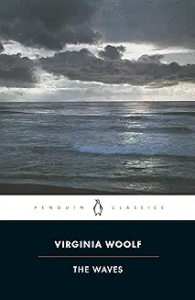
The Waves by Virginia Woolf 1931
“The crystal, the globe of life as one calls it, far from being hard and cold to the touch, has walls of thinnest air. If I press them all will burst. Whatever sentence I extract whole and entire from the cauldron is only a string of six little fish that let themselves be caught while a million others leap and sizzle, making the cauldron bubble like boiling silver and slip through my fingers. Faces recur, faces and faces—they press their beauty to the wall of my bubble—Neville, Susan Louis, Jinny, Rhoda, and a thousand others. How impossible to order them rightly; to detach one separately, or to give the effect of the whole—again like music. What symphony with its concord and its discord, and its tunes on top and its complicated bass beneath….”
This brief quotation from Woolf’s 1931 classic novel, “The Waves” will give you some sense of the shimmering prose, elusive allusions, and complex writing that characterizes this incredible work. I’ve loved Woolf’s “To the Lighthouse” and “Mrs. Dalloway” and have re-read each of them three times, but had never taken on the challenge of this Modernist classic. And having fought my through this thicket to its conclusion, I’m grateful both that I waited and that I read it.
Woolf takes the reader on a complicated journey through the lives of six individuals, referenced above as ‘six little fish’—Neville, Susan, Louis, Jinny, Rhoda, and the narrator of this soliloquy, Bernard. We first meet them when they are children playing in a garden and we say goodby to them in Bernard’s last musings as an old man with gray hair. Rhoda has died by suicide; Jinny continues to seek younger men; Susan is a mother of two and a farmwife; Louis continues to live in his attic room but has achieved status and wealth as a corporate executive; Neville continues to write poetry and mourn the loss of his love, Percival; and Bernard continues to try to capture the mysteries of life, death, time, memory in his writings.
The musings of the characters that take place over their lifetimes are separated by italicized prose stretching over several pages which develops the symbols of the waves, the ever-changing and never-changing movement of the sea over a single day as the sun rises in the East and eventually disappears over the western horizon. This is a very effective technique for emphasizing the brevity and change in the human life while the everlasting and unchanging natural world continues.
The novel is thought by many critics to be Woolf’s best and her most experimental, as well. It’s not just stream of consciousness, but perhaps even further than that, it’s a record of the characters’ subconscious. Often confusing and arcane, the narration goes on uninterrupted by any action except for Percival’s death for 200 pages and often left me struggling. But at the end, I think it was worth it, though a second reading will be necessary to more fully understand the whole picture.
When the book was published in 1931, Louis Kronenberger, who was drama critic for Time magazine for 23 years, reviewed it in the New York Times and observed that “The Waves” had almost reached ‘the jumping off place’ with regard to the modern form of the novel. He wrote that the novel was more like the ‘stuff of poetry’ with its focus on symbols rather than action. While admiring Woolf’s technique and beautiful prose, he concluded that the novel is ‘far from greatness.’ Sorry, Louis, but you have been proven wrong, as “The Waves” continues to be read as a modern classic today.
I’ll close by again quoting Woolf’s words as Bernard concludes the book with a long review of his and the others’ lives, what he refers to as the “incomprehensible nature of this our life.” “What I call ‘my life’ is not one life that I look back upon; I am not one person; I am many people; I do not altogether know who I am”.
If you’re looking for a challenging book, one that will look deeply into the questions we all ask ourselves as we age, try this one.

